Enneagram Tritype® Test

Katherine Fauvre is an IEA Accredited Professional with Distinction. In 2023 she was inducted into the Marquis Who’s Who in America Biographical Registry. She was also inducted into the International Association of Top Professionals and awarded the Top Enneagram Coach of the Year for 2023, Empowered Woman of the Year for 2024, and voted the IAOTP Top Enneagram Coach of the Decade 2015-2025.
Enneagram Tritype® Test v8
• Comprehensive Testing Instrument
• Based on 24 Enneagram Research Studies
• 10 Tests in 1 with Special Features
• Detects Patterns used by 6s and 9s
• Enneastyle Lexicon Assessment
• Analogous and Tritype® Enneaspreads
• Identifies Type, Tritype® and Stackings

What is Tritype®?
An Overview and Introduction to Tritype®
©1985-2026 Katherine Chernick Fauvre • All Rights Reserved
Tritype® Overview
Tritype®, a 27-point personality system coined and created by Katherine Chernick Fauvre, emerged during her 1994 qualitative research on the "internal experiences" of the types. Her ongoing research suggests that individuals use three Enneagram Types, not just one. These three types occur as the dominant type in each of the three centers of intelligence: head (5, 6, 7), heart (2, 3, 4), and gut (8, 9, 1), combining the idealized images, core fears, and defense strategies of all three types, creating a “new" type unto itself with a more specific focus and worldview. All three types are used in unison, in a rapidly repeating, hierarchical stacking order. The type at the top of your Tritype® Stacking is your "core" type.
Extensive research with tens of thousands of international participants has confirmed that each Tritype® Archetype comprises the character traits of the three types within the Tritype®. These traits within the Tritype® combine to create the 27 unique Tritypes®, each with its own set of core values, needs, fears, and concerns that include: a specific focus of attention, idealized image, core triggers, core fears, desires, blindspots, a sense of purpose, and growing edge, adding significant precision, accuracy, and scope to the Enneagram Typing process.
Research also suggests that the common theme found among the three types within an individual’s Tritype® identifies that individual’s archetypal life purpose and a critical blind spot to self-awareness. In addition, the shared view by the types in an individual’s Tritype® gives important clues as to what is needed to live a more conscious and meaningful life. More on Tritype® archetypes below.
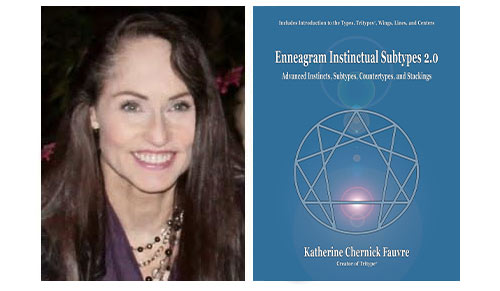
Enneagram Instinctual Subtypes 2.0:
Advanced Instincts, Subtypes, Countertypes, and Stackings
©2026 Katherine Chernick Fauvre • All Rights Reserved
Super Megabook on sale now on Amazon
This is Katherine’s most advanced and comprehensive book on the “Enneagram Instinctual Subtypes 2.0: Advanced Instincts, Subtypes, Countertypes, and Stackings.” Includes Introduction to the Types, Tritypes®, Wings, Lines, and Centers. It explores the Instinctual Types, Subtypes, and Instinctual Drives, later known as Instinctual Variants, from many perspectives.
Katherine’s work with the Enneagram began in 1985. Nine years later, in 1994, she conducted the first of 24 qualitative research studies on the “Internal experiences” of types with many thousands of 3-hour interviews. Claudio Naranjo validated her research findings on the Instinctual Types and Subtypes in 1996.
This 390-page full-color Megabook includes the wisdom of the 9 Enneagram types from the types themselves. It is supported by visual aids, easy-to-reference charts, and Enneamaps on every topic to illustrate how it relates to the Enneagram. The book also includes an introduction to the Enneagram Types, Tritypes®, Tristar, Centers, Wings, Lines of Connection, Research Studies, and an extensive Historical Timeline of the Enneagram of Personality.
• Full-Color Premium Paper Mega-Book and Kindle Ebook on sale now
As promised: Coming in 2026!
Enneagram Tritype® Advantage 2.0: Strengths, Struggles, and Strategies
What is the Enneagram Tritype® Test?
Learn how to take the Enneagram Tritype® Test v8
Sample Test Results
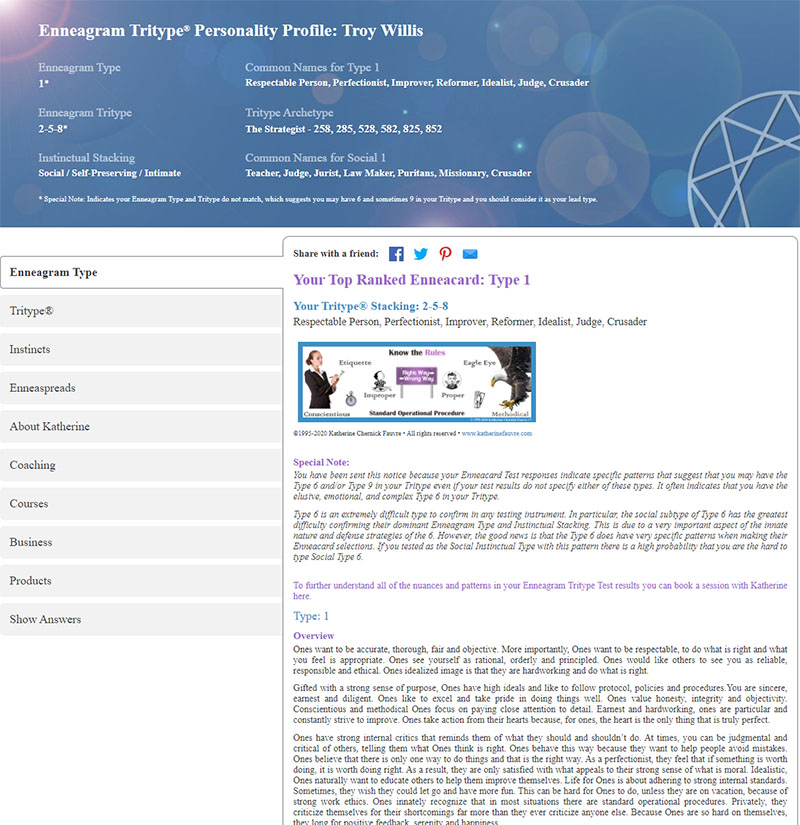
Enneagram Tritype® Test v8
What is the Enneagram Tritype® Test based on?
The Enneagram Tritype® Test is based on over 40 years of experience, 25 of Katherine’s Qualitative Research Studies on the Enneagram over a period of 30 years, as well as Tritype®, Instinctual Types and MBTI, and many other correlations. You can learn more about the Enneagram Types, Tritype® and Instinctual Subtypes at www.katherinefauvre.com.
Enneastyle Questionnaire
The Enneastyle Questionnaire is the first portion of the Enneagram Tritype® Test. This is the open-ended testing instrument that led to all of the studies that followed, as it proved to accurately identify one’s self-image.
Make sure to answer all of the questions based on what has been true for you most of your life, most of the time… not who you could be, should be, want to be or have become.
It is critical that you answer as you are now and have always been, regardless of how much you have grown or changed. Your Enneagram Type is the "you" from childhood to now... the "you" that has always been present regardless of the circumstances. Situations change, but Type doesn't.
Enneacards
The word choices on the Enneacards came from tens of thousands of research participants and thousands of qualitative interviews and In-depth Coaching Sessions.
You will receive several sets of 3 Enneacards and be asked to drag and drop the cards into an order of first to third based on what is true for you most of your life most of the time.
The Enneagram Tritype® Test is a highly individualized testing instrument that adapts to the choices you make throughout the testing process. As you progress through the Enneacards section of the test, if you notice you are seeing Enneacards you have already seen and ordered, know that it is based on what you previously chose and that the test is revealing key patterns indicative of particular Types (in other words: the test is honing in on your Type, trust the process). This will be reflected in your test results and any special notices you receive with your test results.
How to take Enneagram Tritype® Test v8
How it Evolved; Why it Works when you Understand it!
The Enneagram Tritype® Test didn’t come about by chance or a casual whim. It was born from over four decades of observing a persistent, frustrating pattern among Enneagram enthusiasts in search of self-knowledge: people mistyping themselves by focusing on their behaviors rather than their deeper, often hidden motivations that truly define their Enneagram types and Tritypes®. For some, this confusion can lead to years—sometimes decades—spent trying on types, wondering why they do not have the “aha” moment of certainty or the ability to use the system to create the meaningful and lasting change they desire. Many end up trying to make sense of inaccurate types, leading to unintentional and misguided self-understanding.
Backstory
I did not need a new test; however, I felt test-takers did, due to these common mistypings. Recognizing this, I committed significant time, energy, and resources to develop a tool that could navigate the intricate patterns underlying the Enneagram Personality Types. During the stillness and pause of the 2020 pandemic lockdown, I found a rare programmer who could translate these complexities into a precise, responsive digital test. He was an advanced programmer who could incorporate the testing patterns I had observed for four decades.
Together, we developed the Enneagram Tritype Test Version 8 (ETTv8), a carefully crafted testing instrument comprising 10 individual tests seamlessly integrated into a single platform. It was designed not only to measure surface traits, but also to illuminate the inner dynamics of the Enneagram Types and the three types that form each person’s Tritype®.
What sets this test apart are its intelligent alerts—special notices that signal when test-takers may be caught in common mistyping traps, especially involving Types 6 and 9. These “adaptable primary types” at the core of each center within the Enneagram are hardwired to blend behaviors and deflect recognition of the idealized images they must maintain, the core fears that arise if an idealized image feels threatened, and the strategies employed to defend their view of reality. They do not realize that the motivations at the core of their behavioral process are an innate part of their defense strategies. This pattern can derail the typing process and lead to frustrations. The test invites users to look beyond their observable actions and dive into the motivations that lie beneath their behaviors, helping them shed the need for a “perfect” behavioral description.
When understood and applied with an open mind, the Enneagram Tritype® Test becomes a powerful compass. It guides people past the mirages of behavior and onto the terrain of motivation, providing clarity and precision. This clarity prevents the common pitfalls of mistyping that often trap seekers in false identities, freeing them to embrace a more authentic and transformative self-awareness—sooner rather than later.
If you take the test and encounter a special notice, don’t ignore it. Consider it a meaningful invitation to explore deeper—to consider that you may be identified with the need to focus on current situations and behaviors rather than on the adjectives that define the overarching personality qualities that are permanent character traits and not situational. Your type and Tritype® are based on your motivation. Listen with fresh ears to your inner voice beneath the surface. When motivation and fear come into focus, the fog of mistyping lifts—and the true Tritype® shines through.
©1984-2025 Katherine Chernick Fauvre • All rights reserved • Permission with Proper Citations
10 Steps for Taking the Enneagram Tritype® Test
1. Take the test with an open, curious mindset.
The Enneagram Tritype® Test v8 (ETTv8) is not a conventional personality quiz—it is a diagnostic tool designed to detect patterns beneath the surface. Be willing to explore unexpected results rather than dismiss them.
2. Shift your focus from your behaviors to your motivations
Understand that true Enneagram typing—and Trityping®—is not based on what you do, but why you do it. Behaviors are fluid and adaptive; motivations are enduring and reveal the inner architecture of your psyche.
3. Consider how your motivations have shaped your life.
Reflect on your lifelong idealized self-images, core fears, and defense strategies, and how they’ve shown up across your lifespan. Your Tritype® will reflect a consistent pattern of motivational drivers across the Head (5, 6, 7), Heart (2, 3, 4), and Gut (8, 9, 1) types.
4. Choose from your lifelong character traits, not your habits.
Pay attention to adjectives that describe permanent qualities and traits you’ve displayed consistently over your lifetime, rather than situational behaviors or current coping mechanisms.
5. Be aware of common mistypings.
Even if you do not resonate with Types 6 or 9, be aware that these types are known for blending and deflecting, adapting and avoiding, as an innate part of their defenses. This commonly leads to mistyping. Realize you may unknowingly have the 6, 9, or even 3 in your Tritype®—types that often struggle to recognize their idealized self-images, core fears, and defense strategies. These types are naturally adaptive and often misidentified due to their defense mechanisms.
6. Explore your Tritype® as a synergy of three types.
Realize that your Tritype® isn’t just three separate types—it is a unified personality structure made up of your dominant types in each center. These merge, forming a new archetype with a specific focus of attention and worldview, based on the combination of three sets of idealized self-images, core fears, and defense strategies.
7. Accept the difference between identification and truth.
You may identify with a type due to roles, wounds, or social conditioning, but that doesn’t mean it’s your core type. Allow the test and your inner inquiry to reveal who you are underneath your adaptations.
6. Your Test Results: Pay attention to the alerts and special notices.
If your test results flag a potential mistyping, don’t disregard it. These alerts are built in to point you toward blind spots in self-perception—especially when motivations are masked by learned behaviors or roles.
9. Understand that transformation comes from motivation.
Behavioral change is superficial unless it stems from an understanding of the motivations and fears that drive it. The Enneagram Tritype® Test is a tool for accessing this deeper domain.
10. Trust the process and revisit as needed.
Self-awareness unfolds in layers. You may return to the test with new insights and clarity over time. Each pass offers a deeper understanding of your inner map. Compare and contrast different experiences that have troubled you. Go beyond what happened or who was at fault to explore: Why were you upset?Why did you react the way you did? Discover the deeper idealized images you maintain to feel safe, identify the core fears beneath your fixed beliefs, and the defenses beneath your dogmatic convictions.
©1984-2026 Katherine Chernick Fauvre • All rights reserved • Permission with Proper Citations
Enneagram Tritype® Test Reviews
🙃 woe is me
not really pleased 😕
I get all the 6 and 9 notices but when I read the types stacking etc and nothing in them resonates with me at all. I don’t plan for any contingency plans, and I couldn’t think of anything worse than joining anything remotely linked to sheep mentality I absolutely hate the idea of being commonplace and 6 is literally called the everyman/woman. I feel like the universe is telling me that I’m to give up thinking of myself as someone unique already have to deal with having brown hair,brown hazel eyes, average height,weight etc you can’t get more commonplace than that.. and don’t get me started on the even more common type 9 …. obviously all of this is just proving the test is right and I’ll just go and implode on self loathing in the corner over there
First timer
While reading the results of the test I was overwhelmed by how accurate the description of my personality was… reading it aloud you would definitely agree it was spot on.
Gifted teacher and healer.
Katherine was very insightful, holistic and empathic in exploring my choices of cards, and the rationale for my decision-making. She reconciled the descriptors, and self-images, with my card choices, and helped me understand how these reflected my experiences of being with others, throughout key times in my life. She used her ability to interpret microexpressions as a helpful adjunct.
I cannot believe so much was covered in this session. I am very grateful for her contribution to understanding human motivation, spirtuality and integrity.
Thank you.
I am not that positive 😬
Most of my life, I’ve been easy going and stuff but I’ve been through a lot and am not as conflict avoidant. I battle some mental health problems like PTSD so the 279 feels off but I still think the test is worth it. I just think there can be complications so that it doesn’t fully feel true. Also, I’m an SX2, I think but maybe I am wrong. I do also relate to Naranjo’s SX9.
Very strange
I have been studying Enneagram since the 1980s and always test to be a 1. I thought I was a sexual 1 with a strong 2 wing. I might do this test again. I am 72 now and have done a lot of work in Therapy, in Al Anon and in Meditation. I wonder if this is why I show as a 6
Response from Enneagram Tritype® Test v8
In case it helps many archetypes of the 6 and 8 were lost in the dissemination of the Enneagram. I have new excerpts from Enneagram Tritype® Advantage from my advanced research on the types, Tritypes® and Subtypes at https://katherinefauvre.com/tritype
More reviews below.
Social Media Influence on Enneagram Typings
The advent of social media has significantly altered how society engages with personality systems, particularly the Enneagram. While these platforms have made information more accessible, they have also contributed to widespread distortion, misinformation, and overgeneralization.
The rise of self-proclaimed “instant experts” makes it increasingly difficult to determine the qualifications or credibility of those dispensing advice. It is essential to consider the background and training of those offering guidance. Above all, follow your internal compass and remember that every type has both gifts and challenges. It is the health of the individual, not the type itself, that determines whether their behavior is constructive or harmful.
During the typing process, many individuals turn to social media to gather information, gain insight, or simply discuss their types. This is especially true of Type 6, who are innately hardwired to seek the perspectives and experiences of others as part of their process of discernment. How we engage with social media is shaped by our Enneagram Types and Instinctual patterns. Some types prefer observing over commenting; others ask no questions but readily contribute their views. Still others engage socially for connection or use the system as a framework for exploration with like-minded peers.
However, many become discouraged from identifying with their authentic Enneagram Type due to the frequent mischaracterizations and hostile portrayals of the types circulating online. Certain types have been disproportionately criticized and mocked, often reduced to shallow caricatures through memes and soundbites that erase their depth and complexity.
In this environment, wounded or unhappy individuals tend to feel freer to be impolite, especially when hiding behind anonymous usernames. Shielded by the illusion of invisibility, they often project their unresolved emotional pain onto others by scapegoating the types they associate with past hurt or betrayal. This is a common defense mechanism when unresolved wounds are triggered and projected outward.
Rather than engaging in introspective growth and expanding their understanding and compassion for all types, even those that have caused them pain, it becomes easier to vent frustration in online communities without accountability. This venting becomes a form of emotional displacement, where old wounds find temporary relief through the demonization of an entire type.
In addition, users often post content rooted in limited observations, superficial stereotypes, or personal bias, rather than informed research into the hidden suffering of each Enneagram Type, Tritype®, Instinctual Type, and Subtype. Algorithms reinforce this pattern by promoting emotionally charged content that receives high engagement, regardless of accuracy. The result is a distorted public image of certain types, especially those more frequently misunderstood or controversial, such as Type 8 (Challenging Protector), Type 4 (Romantic Individualist), and Type 6 (Loyal Guardian). Once these types are painted in a negative light, it becomes socially risky to identify with them. As a result, many begin to unconsciously dissociate from the type that may, in fact, reflect their core motivations.
Those who have been hurt by individuals of a certain type may unconsciously reject that type entirely, overlooking the possibility that it may actually be their Truetype. This reactive avoidance creates blind spots in the self-discovery process. Instead of recognizing the patterns that reflect their internal world, such as their core fears, idealized self-image, and defense strategies, they remain entrenched in projection. As a result, many people mistype or Mistritype®, bypassing the types that most accurately reflect their wiring. This delay in accurate identification can stall personal development and block access to the neutralizing influence of one's Tritype® through the integration of its Holy Virtues, Holy Ideas, and Holy Actions—essential elements needed for true transformation.
Further complicating this dynamic is the rise of Enneagram “aesthetic” culture, where types are reduced to curated color palettes, fashion choices, and lifestyle branding. While this may make the system more visually relatable, it undermines the integrity of the Enneagram as a tool for deep psychological insight.
These shallow portrayals reinforce caricatures and leave little room for the complexities of defense strategies, instinctual stackings, or Tritype® layering. Individuals begin to compare themselves to these oversimplified archetypes rather than exploring the richness of their inner experience. While all of this is normal human behavior and to be expected, it highlights the need to distinguish between playful characterizations intended for entertainment and the deeper, often hidden, motivations of the types—and to respond accordingly with discernment and care.
To reclaim the integrity of the Enneagram typing process and find one's Truetype and correct combination of types, it is essential to separate emotional associations and online conditioning from the deeper motivations that define the types. Truetyping is not about surface traits or trending aesthetics; it is about identifying the triad of types that contain the idealized images, core fears, and defense strategies that trigger the passions, fixations, and convictions that govern one’s internal narrative. Until this distinction is made, people will continue to avoid certain types based on public perception rather than personal truth, missing the very insight that could reduce their suffering and initiate the transformational process.
©1984-2025 Katherine Chernick Fauvre • All rights reserved • Permission with Proper Citations
Katherine Chernick Fauvre's Youtube
Book a Session with Katherine
Free Events and Q&A's
Instinctual Types in Relationship
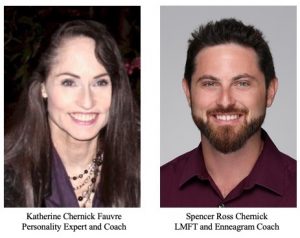
Learn how the Subtypes explain specific nuances of type. Discover easy formulas to explain Subtypes. Watch Katherine Chernick Fauvre and Spencer Chernick discuss using Subtypes in pair bonding and relationships with partners, children, co-workers, family, and friends.
What: Instinctual Types in Relationship
When: Coming in 2026
Time: 4:00-6:00 pm Pacific (California time)
Format: 2-hour online event
Watch the previous parts of the Relationships Q&A Series here
Free Relationships Video Series
Learn how the Tritype® System explains specific nuances of type. Discover easy formulas to explain Tritype®. Watch Katherine and Spencer discuss how to use Tritypes® in relationships.
Watch here
Coaching Endorsements
"Being incorrectly typed takes the power out of Enneagram work. I cannot say enough about the need to be correctly typed! I had mistyped myself, and for a number of years felt quite satisfied with being an Enneagram Nine. Making the decision to learn about Tritype, opened up the possibility for me to learn my Truetype. After meeting with Katherine and realizing I was a Type 2, Tritype 269, I truly felt like an entirely new world had opened up. Now the hard work could begin! Katherine’s expertise in this area is preeminent. I am incredibly grateful for her keen insight in helping me see myself as I truly am, not as I wanted to see me."
- Ann R. Kohl, RN - Enneagram Coach
"Katherine made me feel listened to as she went through the in-depth inquiry process. She asked the right questions to understand my psychology - and successfully went past my superego to counter-check my defensive strategies. She was very kind during the whole process and very professional in explaining her observations. It was a great session! It was entertaining and very informative. I'm glad to have found my True Type. If you want to do something intelligent and to have an in-depth evaluation of your Enneagram defensive strategies then I strongly suggest you to book her services. You will not regret it."
- Alessio David Ricioppo Parra - Enneagram Coach
Why use the Enneagram?
- Honors personality diversity
- Recognizes 9 views of reality, all of which are inherently valid
- Identifies why you do what you do
- Helps you to develop critical self-awareness
- Improves your relationships with others
- Helps to build cohesive groups, families, and teams
- Develop compassion for others
- Is a greater catalyst for change than any other personality typology
What is the Enneagram?
The Enneagram (pronounced “any-a-gram”) is a personality system with roots in ancient Middle Eastern spiritual traditions. “Ennea” is the Greek word for nine, and “gram” means drawing or graph. The Enneagram symbol is a circle enclosing nine equidistant points connected by nine intersecting lines.
As we know it today, the Enneagram is a vital link between the psyche and the spirit. It is a complex and sophisticated conceptual system that is also a sensible and easily understood self-discovery tool. The nine points represent how the nine different personality types perceive and defend their realities.
The Enneagram types are distinguished from one another by unconscious motivations and preoccupations that produce patterns of perception, feeling, and behavior, which can be gifts or obstacles to the personality.
The nine points represent the ways in which the nine different personality types perceive and defend their realities. The Enneagram types are distinguished by unconscious motivations and preoccupations, which produce patterns of perception, feeling, and behavior, which can be gifts or obstacles to the personality.
The wisdom of the Enneagram is that it recognizes nine very different yet inherently valid views of reality. The power of the Enneagram is that it is a profound and comprehensive tool to harness and transform self-defeating behavior into life-enhancing personal empowerment. The gift of the Enneagram is that through self-discovery, one can create and sustain meaningful and lasting relationships.
The Enneagram is a useful tool in determining personal patterns of relating and in understanding differing styles of communicating. Through deeper insight, one can more fully understand one’s own communication style, as well as the styles of others.
With this knowledge, one can observe the core triggers that influence one’s ability to successfully respond to any given situation and avoid ineffectual, self-defeating reactivity. Ultimately, the Enneagram is an invaluable tool that defines nine distinct life strategies that, when understood, can give crucial insight into developing the self-awareness needed to create change.
Understanding the Enneagram
Many personality typologies identify important character traits, which in and of themselves are very instructive, but only the Enneagram identifies the specific core motivations and often unconscious unmet needs (real or imagined) that may cause the personality to go on red alert and react defensively.
The beauty of the Enneagram is that it is a very simple yet complex personality tool that is easily understood. This is due in part because each of the 9 types has a very specific way in which their view of the world is organized.
Once you recognize that your view of the world is along the same lines as one of the nine Enneagram Types, you can begin to examine the predictable ways you will react or respond to different situations. Then you can use the same considerations when determining your Tritype® Stacking and Instinctual Type and Subtype Stacking.
It is truly transformational to discover your Enneagram Type, Tritype® and Instinctual Type because once confirmed and understood, it is easy to pinpoint the moments and issues that will cause your defense strategies to go into overdrive.
With this knowledge, it is easy to recognize the very predictable defense patterns of the types. More importantly, with experience, you can discover your own personal triggers and track the ways in which your defense strategies work to protect you in times of stress.
Learning to recognize the micro movements, micro gestures and micro expressions that you use and those that signal the possibility of impending distress and potential conflict will give you the much needed time to intervene on your own behalf; long before you have become mired in frustrations or a fixed point of view.
Then you can begin the process of creating meaningful and lasting change.
History, Evolution, and Timeline of the Enneagram Types, Tritypes®, Instincts and Subtypes
Note from Katherine: A student of many teachings
Katherine had the good fortune of learning directly from the first Enneagram teachers and authors, including Oscar Ichazo and Claudio Naranjo. She certified with The Narrative Tradition, Helen Palmer-David Daniels, Don Riso-Russ Hudson, and Kathleen Hurley-Ted Dobson (later Theodorre Donson) and knows their work at a master level. In addition, She has conducted 24 completed research studies with tens of thousands of international participants, thousands of qualitative interviews, and In-depth Inquiry Coaching Sessions.
Katherine has stated, that she was forever changed by having had the opportunity to meet and study with such amazing people and teachers.
To read the full History, Evolution, and Timeline of the Enneagram: Types, Tritypes®, Instincts, Subtypes and countertypes, and of who added what, where, and when:
https://www.katherinefauvre.com/indepth-history-of-enneagram
Why is knowing all teachings important?
Katherine's ongoing research studies validated the value of both Ichazo's Trifix and Naranjo's Instinctual Subtypes
Her first research findings on the 'internal experience' of the nine types and three Instinctual types revealed many key distinctions and nuances of the types and led to the creation of what is now known as Tritype®.
What is noteworthy and of interest is that these studies validated and continue to validate Ichazo's Trifix and Naranjo's subtypes, and in particular, the advanced theories they added after 1971.
Especially meaningful is that the initial studies and resulting findings of her 1995 research studies, Enneastyle, and the Instinctual Subtypes, were conducted and evaluated before she met Naranjo and had learned of his corrections and additions to the Enneagram and his subtypes before she knew of Ichazo's Trifix.
This suggests that the fears, concerns, preoccupations, coping mechanisms, and defense strategies of the Enneagram Types, Trifixes, Tritypes®, Instinctual Types, and Subtypes can be observed and, with awareness, understood.
Therefore, Katherine feels that it is imperative that one combine Ichazo's and Naranjo’s later views on the Enneagram. In addition, it is also deeply enriching to add the views, fears, and concerns of the nine types as revealed by thousands of her study participants and her interviews with tens of thousands of test-takers.
Accurately Typing Oneself and Others
Katherine believes that combining all of these approaches makes it much easier to accurately type oneself and others. It also makes it easier to understand the 'internal experiences' of the types and the processes operating at the most primal and fundamental levels of the types' defense strategies.
With this knowledge, she feels one can create and sustain meaningful and lasting relationships.
Behavior vs Motivation
Pay attention to what is motivating your behavior and not the behavior itself. This is crucial to accurately type oneself. This is especially difficult for the Type 6 and a small number of 9s to do because their defense strategies are designed to track behavior rather than motivation.
©1995-2023 Katherine Chernick Fauvre: Originator of Tritype®
https://enneagramtritypetest.com/enneagram-test/
Endorsements
“Katherine's Enneagram expertise and instruction increased our team's ability to relate with another on a business level. Moreover, her teachings at the Federal Reserve Bank over the years helped me understand more about myself as a person, and I've taken her instruction with me well after I took her classes. Working with Katherine was a profound and important milestone in my life.”
April 14, 2011, hired Katherine more than once as a Business Consultant
Top qualities: Great Results, Personable, Expert
-Keane Li
See more endorsements
Enneastyle and 9 Types of Empaths Research
How do I find my type of Empathy?
©1995-2023 Katherine Chernick Fauvre: Originator of Tritype®
How do I find my Types of Empathy?
Enneagram and 9 Types of Empaths
A few thoughts on Empathy and Empaths… Katherine began researching the different ways in which people experience and express empathy in 1969. Her research has continued to suggest several different types of empathy. Katherine has found that it is helpful for people to understand how they experience and express empathy... to be able to increase their emotional intelligence and develop the compassion needed to create lasting change in their lives. Empaths are highly sensitive people but are not always emotionally mature people. So, developing one's capacity for empathy and sympathy is one of the greatest ways to enhance our emotional intelligence, personal growth, and create community.
Cognitive Empathy:
Intuitive knowing and understanding
This type of empath has an intellectual understanding of what others are thinking and feeling. They recognize that others may be in distress and in need of assistance. They offer support by giving a logical approach to managing emotional states. They help others by mentally assessing what is needed.
The high side of this type of empathy is that they can deeply understand what others need, think and feel. They can be very wise. The low side is that they can use this understanding to manipulate others. Sociopaths can have this type of empathy and be devoid of any sympathy for the feelings of others.
Emotional Empathy:
Sympathetic resonance
This type of empath emotionally and physically feels what others are feeling. Emotional empaths feel what others feel as though they are their own feelings...
The high side of this type of empathy is that they can attune to others and can truly know what another is experiencing. They are identified with their depth of feeling. The low side of this type of empathy is when they can’t manage their own emotional states... and focus only on their own distressing emotions, often hysterically acting out their emotions. As a result, they can emotionally burn out and/or feel like emotional vampires to others.
Physical Empathy:
Physical sensations
This type of empath is very sensitive and may not know how empathetic they actually are. They feel empathy through bodily sensations without a connection to their deeper inner knowing or their emotions. These signals may be pleasant or extremely uncomfortable. When someone near them is in distress, they may experience the uncomfortable sensation without realizing what is causing them to be so irritable and uncomfortable.
The high side of this type of empathy is that they know through their physical sensations what is true in the moment regardless of what is being said or done. They know when something is off. They often offer advice and solutions to fix whatever may be causing distress to others.
The low side of this type of empathy is that they are easily overwhelmed by negative sensations and have trouble tolerating the distress of others. They can be hyper-focused on fixing or getting away from the person in distress rather than demonstrating care. To manage their emotional sensitivity, this type of empathy may shut down to the point of appearing calloused, cold, and indifferent.
Compassionate Empathy:
This is our goal and requires emotional intelligence and maturity. This type of empath can read others. They see, know, feel, and sense what others are thinking and feeling. They understand the predicament of others and demonstrate care and concern through sounds, words, and gestures. They readily feel the emotion and may feel like crying but will contain their own emotional empathic response in service of others, and instead step in and offer assistance in the manner that it is needed.
Biological Empathy:
Empathy appears to be inherited just as aggression and shyness are... which is why some people are naturally more empathic than others. We have a gene that may increase or decrease our innate capacity for empathy. We inherit our bandwidth for empathy, which is why some children feel pain when another child is hurt and cries while other children do not seem to be impacted.
Maturational Empathy:
Generally speaking, between 9-11 years of age, we have enough ego development to expand our empathy by understanding our impact on others. Ideally, with the right guidance, we can develop this type of empathy. But, even if we didn’t have the benevolent kindness of a guiding mentor, it is never too late to develop this capacity. We call this sensitivity with emotional maturity.
Experiential Empathy:
This type of empathy comes from having experiences. Some people might not be able to truly understand what another might be feeling and/or experiencing until they, too, have had the same experience. For example, they might feel sympathy for someone that lost their job... but if they also lose their own job, they might then move from having sympathy to having both sympathy and empathy. They now know on a personal level what it feels like to lose a job and have developed empathy for those that have lost their jobs.
Spiritual Empathy:
This type of empath is often described as an ‘old soul’. With this, empathy, compassion, and understanding are always present even if their behaviors are immature or reactive. The spiritual empath does not need to have had the experience to know what another is feeling. This type of empathy is what motivates us to create bonds and build bridges of community.
Spiritual Empathy is what connects us to one another on a universal level. This is why we care and are impacted when we see or hear of the other's suffering. Charity is born out of this type of empathy. When we recognize that we are deeply interconnected to all things great and small, we engage with and wish to support the needs and concerns of others. This is why we can feel moved to help a total stranger that is in distress.
Shutting down Empathy:
We all have empathy but in varying degrees. With empathy, we are able to put ourselves in another’s shoes, understand what is needed at any moment in time, and make informed decisions. Because empathy gives us the ability to know what others are thinking and feeling, it improves our decision-making processes.
However, there are times when the ego shuts down empathy due to empathy overload. This may be for a few seconds or much longer.
This is necessary for us to do in order to manage the adrenaline that comes from overwhelming distress. The defense system manages this distress by disassociating from the overwhelm of the empathetic feelings. It is usually immediate but temporary. It gives us the time needed to recognize solutions and take the appropriate action for a problem. This is needed because we are unable to make informed decisions when we are in a highly emotional state. Once we have a potential solution to a problem, we usually return to our natural empathetic style.
When and why do we shut down?
When we are hurt and/or in an argument with someone, we often shut down our empathy to manage the pain we are feeling, whether it is real or imagined. This is when we might say or do something we regret. Later, when our emotional states are no longer in overdrive, we can restore a sense of calm and apologize.
In order for the species to survive, people will have some degree of empathy, even if it is a tiny amount. Someone with a small amount of empathy might use it to manipulate and take advantage of others to increase their chances for survival. Others with greater amounts of empathy might instead use their empathy to help others survive in addition to their own survival.
Regardless of the level of empathy, we all need to be able to shut down our empathy at times in order to survive. If we did not have the ability to shut down our empathy, we would also not be able to survive as a species. I see this as a biological imperative.
Empathy shutdown can last a few seconds, or in extreme situations, last a lot longer depending on the intensity of the distress, the duration of the distress, and/or what values one has been taught or both.
If we were in full empathic resonance with others at all times, we would never be able to kill to eat or protect ourselves or those we care about from life-threatening danger. For example, soldiers need to be trained to shut down their empathy in order to be able to kill. They are taught to demonize the enemy and act with prejudice in order to survive going against the enemy.
The empath with a high level of empathy has a greater capacity to understand the suffering of others. However, when one understands the suffering of others, they, in turn, will suffer until they learn to manage their empathy and turn it into sympathy.
Being hurt or seeing someone else being hurt is extremely painful and upsetting for the empath with a moderate to a higher level of empathy. But even then, an empath with a high level of empathy may shut down their emotional empathy if they are repeatedly harmed or humiliated or need to protect someone else from the same. This type of wounding creates deep scars in the empath’s psyche, but with emotional support, this indifference can be healed, and the innate caring and compassion of the empath may re-emerge.
The Enneagram is a powerful tool for building bridges and understanding ourselves and others in a deep and profound way. It an ancient symbol of unity, diversity, change, and transformation. The building blocks for a supportive community can be found in the innate ways the 9 types demonstrate empathy. This is due to the fact that empathy is the way we connect to one another.
There are 9 types of empathy and 7 levels of empathy. There are also 9 Enneagram types, each of which expresses and experiences empathy in a very specific manner. Understanding the 9 diverse ways the 9 types express empathy helps us understand the ways in which others may be demonstrating compassion and consideration.
We can appreciate the diverse ways others may show us compassion and consideration. This is key as each type demonstrates empathy according to the needs and concerns of their own Enneagram type. We can miss the signals of empathy that other types are demonstrating, simply not know how to read the other type's style, and often feel let down when their way is foreign to us. So, for example, a 5 will demonstrate empathy by sharing the knowledge that they have acquired to be of assistance.
To create and sustain meaningful relationships, we need to develop our emotional intelligence and sense of personal empowerment. To feel empowered, it is essential that we be critically self-aware; recognize our values, goals, and skills, and our impact on others.
When we discover our style of expressing empathy, we can make sense of our world and the struggles we face in a new way. Empathy connects us to one another and gives us the compassion needed to build a community that honors and appreciates diversity.
©1995-2023 Katherine Chernick Fauvre: Originator of Tritype®
Katherine's research with empathy began in 1969. To learn more about the Enneagram and Empathy, you can purchase Katherine's in-depth work here
About the course:
9 Types of Empathy, 7 Levels of Empathy, 9 Types of Empaths and Personal Empowerment 3-week Masterclass Recording: Advanced Series
Empathy is the invisible thread that connects all of us to one another. It is our innate sense of humanity. It is the ability to understand and share the feelings of another to put ourselves in their shoes. All 9 types experience and demonstrate empathy, but how? And why does it seem like some types have more empathy than others? Discover how the 9 Enneagram Types and 3 Instinctual Types experience and express empathy… and how we may miss the manner in which loved ones show us compassion according to their type.
As promised, I am now offering a 3 week, in-depth intensive expanding on the concepts that I am discussing in the Enneagram Global Summit.
In this online course, I will be teaching about my study of empathy. I will cover the subtleties of the 9 Types of Empathy, The 7 levels of Empathy, and The 9 Types of Empaths. In addition, I am including what is needed to understand your type of empathy and the steps to become more personally empowered.
I will expand more on:
• The 9 Types of Empathy
• The 7 Levels of Empathy
• Tips on Personal Empowerment for the 9 Types
• How you can use Empathy and Personal Empowerment to work with the Types in a new way
• How Empathy can be better understood in relationship to the Tritype and how the expression of Empathy can differ by Tritype
For example, some Tritypes like the 269 express empathy in the way they personally tend to others, and other Tritypes like the 358 will express empathy by providing for others. Another example is that the 146 Tritype is focused on their sensitivity to pressure and "getting it right," so they will express empathy by helping to find and implement accurate and specific solutions in a caring way.
My study of Empathy began with a term paper in 1968. Empathy, like the Enneagram, has the power to transform people and situations. I have come to learn that empathy is the invisible thread that ties us to one another. When we have empathy for others and ourselves, we have the ability to express and speak the language of compassion. With empathy, limiting beliefs fall away, and all differences are forgiven and understood.
Since that first term paper, I have taught my findings in a number of diverse settings— from the board room and executives in department stores to high schools and universities and even in the county jail. Over the years, I learned a great deal more about empathy and how to recognize the different ways empathy can be expressed and why. I have conducted interviews in businesses, in courses, within families, and in coaching sessions. I have continued to learn more about the ways in which people think in terms of empathy. And, like the Enneagram, empathy, when more fully understood and correlated with the Enneagram Types, is deeply compelling and life-affirming.
Take the test here.
Learn more about Tritype® here:
https://katherinefauvre.com/tritype
Have you mistyped yourself?

Free videos on Katherine's YouTube Channel:
- Why People Mistype Themselves watch here
- What is Trityping? watch here
- 20+ points to consider when Typing watch here
- The Internal Experience of Type watch here
- Enneagram Typing is about Motivation Behind Behavior watch here
- What are Micro Expressions? watch here
A Free Video Event with Katherine Fauvre:
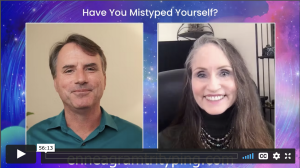
Have You Mistyped Yourself?
Discover how Enneagram Trityping can give you a more Nuanced and Accurate Picture of Yourself!
Watch me with Stephen Dinan, the CEO of Shift Network, as I demonstrate how to use powerful Enneagram tools to more accurately type.
Click here to watch a recording of my free hour-long online event, "Have You Mistyped Yourself?: How Enneagram Trityping Can Give You a More Nuanced and Accurate Picture of Yourself and Others.”
Take your ability to accurately type people using the Enneagram to a new level
Don't miss out!
Join me with Shift Network CEO Stephen Dinan on Saturday, April 23, as I demonstrate in real-time how to use powerful Enneagram tools to more accurately type. Register here
These typing tools evolved over several decades, beginning in 1970 when I first began typing others according to many diverse typology systems, including the Enneagram.
I will introduce key archetypes of the Enneagram types that were missing resulting in some types not fully recognizing themselves. If you have mistyped, you may not recognize how these qualities are governing every area of your life.
I will also share how some of the original Enneagram teachings were lost due to incomplete and/or inaccurate disseminations of the Enneagram, which reveal why it is crucial to get back to the 'origins' of Oscar Ichazo's 'Enneagram of Personality' and Claudio Naranjo's 'Subtypes.' Register here
Without this information, you may miss the opportunity of getting to the deeper, more meaningful aspects of each Enneagram type's emotional needs, fears, and concerns.
I'll introduce some of the tips on typing that will help you type with improved accuracy and help you discover why you may have been mistyped:
- Are you aware of what needs to be considered to accurately type yourself and others?
- Do you know what constitutes type?
- Do you know how you use the defense strategies of each Enneagram Type in your Tritype®?
- And how these three types merge to create a new type unto itself?
- Do you know the way you use your head type, heart type, and gut type?
- Do you identify with the key features of the types in your Tritype®?
During my 23 research studies, I was surprised to learn how many of those who had typed themselves later discovered they had mistyped. Register here
Why did they mistype? Because most people type themselves based on their behaviors and what they do, rather than their motivations... and why they do what they do. Trying to determine your Enneagram type and Tritype® based on your behaviors rather than your motivations makes it hard to see yourself (and others) accurately.
The distinction between your motivations and your behaviors is key to understanding the Enneagram and accurately typing yourself. This is because all other personality typologies are based on behaviors... Whereas the 'Enneagram of Personality' is the only typology based on your motivations and the 'defense strategies' that you use.
Understanding your Enneagram Type, Tritype®, and Instinctual Stacking can dramatically increase your ability to develop the critical self-awareness needed to accurately type yourself and others. In addition to more accurately typing, you can apply the wisdom of these insights to yourself and others, creating the opportunity for radical change and transformation.
This, in turn, will create a sense of internal harmony that will help you develop greater compassion for yourself and others, thus creating a deeper sense of harmony between you and your world.
Explore the Tritype® Archetype system and how it reveals 27 ways the three centers of intelligence -- head, heart, and gut merge to create a more holistic view of type and discover advanced ways of recognizing nuances of the 'defense strategies' that motivate behavior.
Learn why people who have mistyped do not find that they use the gifts of the Enneagram because they do not have a 'felt sense' of type. Register here
Add micro-expressions, body language, and talk style to your typing toolbox to reveal deeper layers of the Enneagram types and to manage the projections, defense strategies, and coping mechanisms that you use every day.
Ultimately, you'll experience how meaningful your life can be when you're grounded in your correct type. Your confidence increases, codependency decreases, and your ability to collaborate and create sustained relationships with others come with a greater sense of ease.
Using these advanced Enneagram typing tools will capture the nuances that motivate your behaviors and will radically transform limiting beliefs, negative emotions, and habitual behaviors into life-enhancing personal empowerment.
We hope you're able to catch Have you Mistyped yourself? How Enneagram Trityping can give you a more nuanced and accurate picture of yourself and others as scheduled. But if you register and miss it, you'll receive a downloadable recording as soon as it's available: Register here
Facebook Interview Recording
Katherine answers questions about the Enneagram, Tritype®, and the Instinctual Subtypes. In particular, she answered questions about the difference between Tritype® and Trifix and how a melancholy 9 can misidentify as a 4. It is usually the 946 Tritype®.
To watch, click here
Watch for Enneagram Global Summit Events
Free but must Register to Attend here
Enneagram Type, Tritype®, Instinctual Type and Spirituality
Were you unable to attend this free interview?
Good News, you can purchase the entire set of 70 video presentations with 11 bonus items as an upgrade in the Enneagram Wisdom Collection 2021:
Special price $97 was $247

In this 2021 Enneagram Global Summit, Jessica Dibb interviews Katherine, Russ Hudson, Sandra Maitri, A.H.Almass (Hameed Ali), Stephanie Davis, Suzanne Dion, Tom Condon, Deborah Ooten, and many other Enneagram teachers and authors.
Katherine's Shift Session:
Your Instinct is the key to spiritual growth. Discover the latest research on the spiritual aspects of the three Instinctual Types and learn how your 'Instinctual Self' triggers your more reactive nature, acting as both an asset and a liability to the 9 Enneagram Personality Types. Katherine Fauvre will explain what the 3 Instinctual Types and 9 Types revealed were the gifts and obstacles to spiritual progress and how your Tritype identifies your innate sense of purpose.
Key Points:
• Learn why your Instinctual Types are at the root of suffering.
• Learn why your Instinctual Stacking is the key to spiritual growth.
• Discover what each Enneagram Type and Instinctual Type report they need on the spiritual path.
• Discover how to use your Tritype® to identify your innate focus and sense of purpose.
Katherine discusses:
• What did each Instinctual Type and Enneagram Type report they need on the Spiritual path?
• What did the Types report were their obstacles along the way?
• Learn how to use Tritype® to work with your Essential Qualities.
• Learn how Tritype® identifies the 3 Holy Ideas and the 3 Holy Virtues you naturally wish to express.
Truly knowing yourself and how you operate is critical in transforming emotional reactivity... into life-enhancing personal empowerment.
Instead of seeing differences, the Enneagram provides a window into why others think, feel and behave the way they do…
Enneagram Tritype® Research Study
Exploring Enneagram Tritype®: Theory and Practice
Abstract
Upon working with a multitude of clients, a fascinating pattern has emerged. Research and test results with clients revealed that people utilize one type in each center of intelligence: head (5,6,7), heart (2,3,4), and gut (8,9,1), and that these types were used in a preferred order, with one being dominant.
These Tritype® combinations also reveal specific character archetypes that enrich and enhance current Enneagram theory and provide Enneagram researchers and enthusiasts with a new typing language. Understanding the basics of Tritype® can help those working with the Enneagram (enthusiasts, clients, therapists, and coaches) communicate in a new typological language.
Aristotle suggested that true internal harmony could be achieved only when internal conditions allow each aspect of the psyche to perform what it was primitively meant to perform. The authors have found that one’s Enneagram Tritype® reveals critical aspects of the psyche and how they were meant to perform, thus allowing one to develop the self-awareness needed to create internal harmony and live a more fulfilling life. Full Tritype® Research
©2012 Katherine Chernick Fauvre • David Fauvre, MA • IEA Journal 2012
©2026 Katherine Chernick Fauvre • Updates and Additions • All Rights Reserved
What is Tritype®?
What is Tritype? What is the Tri-type? What is a Tri type? What is the Tritype Theory? What are the Tritypes? What is the Tristar? How do I find my Tritype? How do you identify your Tritype? What are the Personality Numbers? What are the Enneagram Numbers?
Tritype®, a 27-point personality system coined and created by Katherine Chernick Fauvre, emerged during her 1994 qualitative research on the "internal experiences" of the types. Her ongoing research suggests that individuals use three Enneagram Types, not just one. These three types occur as the dominant type in each of the three centers of intelligence: head (5, 6, 7), heart (2, 3, 4), and gut (8, 9, 1), combining the idealized images, core fears, and defense strategies of all three types, creating a “new" type unto itself with a more specific focus and worldview. All three types are used in unison, in a rapidly repeating, hierarchical stacking order. The type at the top of your Tritype® Stacking is your "core" type.
Extensive research with tens of thousands of international participants has confirmed that each Tritype® Archetype comprises the character traits of the three types within the Tritype®. These traits within the Tritype® combine to create the 27 unique Tritypes®, each with its own set of core values, needs, fears, and concerns that include: a specific focus of attention, idealized image, core triggers, core fears, desires, blindspots, a sense of purpose, and growing edge, adding significant precision, accuracy, and scope to the Enneagram Typing process.
Research also suggests that the common theme found among the three types within an individual’s Tritype® identifies that individual’s archetypal life purpose and a critical blind spot to self-awareness. In addition, the shared view by the types in an individual’s Tritype® gives important clues as to what is needed to live a more conscious and meaningful life.
One of the three types in an individual's Tritype® is the “core” or dominant type and represents the ego’s preferred defense strategy and is in charge of the 3Type defense system. The ego always uses the strategies of all three types in unison in a rapid, repeating, hierarchical stacking order throughout the day, every day. The dominant type will continuously deploy the other two types in the Tritype® to make decisions and solve problems.
It is important to note that just combining the three preferred types, one from each of the three centers, is not enough to explain the attentional patterns of each of the 27 Tritype® Archetypes or to confirm which Tritype® is dominant. We can theorize about which type we identify with most in each triad, but the focus of attention of the Tritype® emerges because of what happens when these three types merge and, in effect, become one type, which is the Tritype®.
This is because the characteristics of all three types influence one another. As a result, some characteristics are amplified, while other characteristics are minimized by the characteristics of the two other types within the Tritype®. These distinct differences explain why each Tritype® is unique.
For example, the 478 Tritype® has the three “creative" Enneagram Types, one from each triad (4,7,8), which include the two types that prefer what is unusual (4,7), the two types that share the line of intensity (4-8), and the two assertive types (7,8) thus creating a type of person that is innovative, creative, outspoken, intense, assertive, deep, sensitive, and unconventional with an original way of doing things.
Having said that, types 8 and 7 combine to override the emotional sensitivity of type 4, so it is more hidden, but it is always there. The intensity of type 4 and type 8 is still there but the type7 brings a lighter touch... If Type 4 is the lead type, the emotional nature of type 4 is more expressed than when type 7 or type 8 is the lead type.
Can your Tritype® Change?
Just as with your primary type, your Tritype® will never change. The only time you may think you have changed your Tritype® is because you have not yet discovered your Tritype®. Unfortunately, there is a lot of misinformation as to what happens when the three types in your Tritype® merge and create the specific focus of attention of your Tritype®. This Trityping® error can happen if you have identified with your behaviors or descriptions of the types and Tritypes® rather than the actual defense strategies you use.
High Side and Low Side of Tritypes®
Just like our Enneagram type, we have a "high side" and a "low side" of these Tritype® interactions that distinguish each as having a separate purpose. The values and concerns of the three types in our Tritype® come together to become the guiding principles in life and give us our sense of values, purpose, and the guiding principles one should follow.
The high side of the intersection of these three Enneagram Types is that they define what gives life direction, focus, and purpose for the individual with that Tritype® combination.
The low side of this intersection is that the defense strategies collude or "miss the mark" in the same way, narrowing one’s ability to accurately self-assess, and may even prevent a person from achieving a higher level of self-awareness by keeping the individual mired in outdated, rigid beliefs.
This collusion is both an asset and a liability. An individual’s strengths are a result of these three types working in concert with one another. An individual’s weaknesses result from this collusion as well, which limits self-awareness and spiritual growth, creating what we term an “egoic" blind spot.
Making this blind spot conscious often releases neurotic symptoms just as aligning oneself with the archetypal energies found in the three types in one’s Tritype® can align an individual with their life purpose and mission. Identifying one’s Tritype® Archetype creates an opportunity to discover one’s innate abilities, develop expertise, and experience a greater sense of satisfaction.
Do Tritypes® have Wings?
Yes, the Tritypes® have wings. Each Tritype® fully represents the entire type, which includes Ichazo’s two wing types for each type. They also have lines of connection that are used both positively or negatively, combining the three Types, which in turn created the Tritypes®. Each of the 27 Tritypes® has wings. The Enneagram of Personality includes these because the Enneagram is a Trialectic System created by Oscar Ichazo.
The Tritype® is made up of three of the nine Enneagram types. These three types represent the dominant Enneagram type in each of the three centers of intelligence, which, when combined, create the 27 Tritype® Archetypes.
Each type within the Tritype® uses all dynamic aspects of the three types, including the wing types and the lines of connection related to the type. So, if the nine types have wings, and they do, then the three types in the 27 Tritypes® have wings as well.
A common source of mistyping the types within a Tritype® is based on a belief that one relates to the types within a Tritype®. This is not the case. The types in the Tritype® are based on the defense strategies of three of the nine Enneagram types. It is important to remember that the Tritype® is not just three types one relates to in each center. Instead, it is based on the defense strategies of the three types merging together, which function as a triad, creating a new type unto itself.
Enneagram Tritypes® are dynamic!
It is helpful to note that the Enneagram types are dynamic due to each type’s relationship to both of its wing types and both of its lines of connection (both of which are patterns of three), and when combined, these forces generate the dynamic energy that create each of the 27 Tritypes®. This process is based on the Laws of one, three, and seven. It is possible that GI Gurdjieff and Oscar Ichazo used this Enneagram symbol because it is believed to map the movement in the universe. It thought to combine Divinity plus creation.
All nine-pointed symbols are Enneagrams. So, each type is a result of the dynamic interplay of the type with its two wing types, which is Ichazo’s Trialectics, and the type with both connecting lines, which is also Ichazo’s Trialectics.
Ways of working with the Tritype® System
Katherine has found that there are two main ways to work with the Tritype® material. The first is to study the differences within type by looking at the Tritype® relationship to those sharing the same dominant Enneagram type. The other is to compare the similarities between people with the same Tritype® across different core Enneagram types. This is referencing the Tritype® archetype.
Example: The Type 1 has nine different possible combinations (125, 126, 127, 135, 136, 137, 145, 146, 147). Through observation of how these different combinations of the Type 1 conceptualize and navigate the social world, distinctions may be noticed depending upon the types in the Tritype®. The other method is to recognize the archetype of each Tritype® combination. Fauvre posits that each of the 27 Tritype® combinations illustrate a particular and individual archetype. These archetypes were observed out of the recognition of the similar core triggers, core fears, life purposes, blind spots, and “growing edges” that seemed to personify how each Tritype® navigated the world.
Example: The 468 (486, 684, 648, 864, 846) has been deemed “The Truth Teller” by Katherine Fauvre. Most research participants who identified this as their Tritype® combination reported similar archetypal patterns that, according to Katherine, warranted this title, such as the desire to track inconsistencies and call off hidden agendas and ulterior motives. According to Katherine, each of the 27 Tritypes® has a corresponding archetype that gives a "snapshot" into the archetypal life path of that particular Tritype® combination. There are books and videos on the Enneagram Tritype® here. Learn more about Tritype® in the upcoming online Tritype® 10-Week Masterclass Trainings here.
©1995-2023 Katherine Chernick Fauvre: Originator of Tritype®
How is Tritype® different from Enneagram Type?
Tritype® theory suggests that we use three Enneagram types that combine to create a new type, with one dominant or 'core' type at the top of the stacking order, while Enneagram theory suggests that we have a single 'core' Enneagram type.
Tritype® can explain the distinctive ways in which each individual manages life using various combinations of ego strategies and coping mechanisms from each center. However, Tritype® (like the Enneagram) remains a theory of motivation and not one of behavior.
©1995-2023 Katherine Chernick Fauvre: Originator of Tritype®
Katherine Fauvre’s Tritype® and Ichazo’s Trifix®
Tritype® and Trifix share a fundamental similarity. Both "Tritype®" and "Trifix" acknowledge that individuals use all three triads or centers.
The distinctions between Katherine Chernick Fauvre's Tritype® theory and Oscar Ichazo's Trifix theory are evident in their names: Tritype® and Trifix, respectively.
Tritype®
Katherine Fauvre's Tritype® encompasses the complete utilization of each type, encompassing fixations, passions, convictions, and the dynamic aspects generated by the primary type's interactions with its two wings and two lines of connection.
Katherine found that with Tritype®, individuals employ the entire defense strategy of their three types, including mental fixations, emotional passions, visceral sensations, and convictions, as well as the defense strategies of the types merging to create a "new type unto itself."
Each Tritype® and Tritype® Archetype possesses a unique focus of attention, incorporating idealized images, core triggers, fears, concerns, desires, and preoccupations that shape a worldview, innate gifts, life purpose, and patterns of defense. They also entail innate struggles and a path of growth and healing.
Katherine arrived at this conclusion while researching the internal experience of types, initially through hundreds and eventually tens of thousands of interviews. It was particularly inspiring for her to discover that Ichazo had also reached the same conclusion that people use three centers and not just one.
Trifix
On the other hand,, Ichazo's Trifix solely focuses on using the three mental "fixations" without considering heart or gut fixations. Fixation or “fix” pertains exclusively to the mental fixed beliefs and preoccupations.
Trifix was not in Ichazo’s 1970 dissemination of the Enneagram. Nor was it taught by Dr. Claudio Naranjo's Enneagram teachings in his Seekers After Truth groups (SAT).
What is key is that Katherine Fauvre and Oscar Ichazo arrived at the same essential truth through separate means: people use all three triads. These discoveries are significant as both theories independently validate that people utilize all three centers.
Comparisons
Katherine Fauvre discovered Tritype® in 1994 during her in-depth inquiry process with thousands of research participants, and people use the "full Enneagram type" of the dominant type from each center of intelligence.
In contrast, Ichazo added the Trifix to his Arica School in 1997 and taught that people use the three fixations from the three types in the Trifix. Enneagram Monthly included two paragraphs on Ichazo’s Trifix in 1997.
Katherine's research, conducted in 1994, introduced the idea that people use three types, not just one. Ichazo introduced the idea that people used three fixations only in 1997. Not understanding the important distinctions that would emerge in 2007, the terms were combined.
From 1994 to 2007, Katherine was the only person to publicly teach and publish on all terms: 3Types, Tritype, TriCenter and Trigram, and Trifix. In 2007, Katherine separated her extensive research from Ichazo’s term in 2007 to clarify important distinctions.
In 2019, Ichazo finally published five general paragraphs on Trifix in his book "The Nine Constituents," but they lacked any detail on correlations or references to head, heart, or gut types. He never taught more on the subject.
In "The History of Integral Teaching" by Ichazo, it is confirmed that Trifix was mentioned for the first time in the Enneagram Monthly article published in January 1997. It was first taught to Aricans in 1997.
Coining of the term Tritype®
Tritype® was based on extensive research with tens of thousands of participants and correlations with Katherine’s Enneastyle Questionnaire (EQ) and her Enneacards Testing Instrument, which continued to reveal many distinct and meaningful patterns. These findings were further confirmed with additional studies that Katherine conducted.
As Katherine continued to write about and teach the 3Types (Tritype), TriCenter, Trigram, and Trifix, it became clear that she was the only one to do so. She always gave attribution to Ichazo for his term and added it to her work to honor him as the creator of the Enneagram of Personality. So Enneagram Enthusiasts confused her extensive body of research on the types, archetypes, and their meaningful interactions with “Ichazo’s single term Trifix, which was three fixations used in a clockwise order from the primary type.”
Katherine met an Arican teacher in 1997. She had also attended Ichazo’s Reunion Intensive in 2005, where she met other Aricans. Later, in 1997, the Arica Institute added Autodiagnosis and Advanced Fixations to the Arica training. This was the first time he had offered the concept of the Trifix to individuals.
In 2007, Katherine taught Trifix in Palo Alto, California. The Arican teacher Katherine met ten years earlier attended her Trifix training. After the training, they enjoyed discussing many aspects of the history of Ichazo’s Enneagons and the Enneagram of Personality and Trifix and her experiences with many different teachings.
Their discussion about the similarities and differences in the systems led to a conversation on the future and how enthusiasts would come to understand Katherine’s extensive body of work based on years of research and Oscar’s singular concept of Trifix. Katherine wanted to separate the term from her years of research. So they discussed ways that could happen without confusing others any more than was necessary.
The Arican teacher mentioned that Katherine had popularized the term Trifix due to teaching public courses, conducting research studies, posting her findings on the internet, and presenting her findings at the IEA conferences. So that she would not have a problem. The internet was rapidly growing exponentially. So was the term Trifix. Her work was well received because most strongly identified with using all three centers of intelligence.
Together, they looked for ways to distinguish her extensive research and body of work work from Ichazo’s concept. They finally found an important distinction. They discovered that Katherine’s research was on the whole type in the Tritype, the use of the three types, and that Ichazo’s concept was only focused on the three fixations of the types in the Trifix.
This meant that what they shared in common was the use of three triads only.
They were happy to find a distinction, and as it turned out, an essential distinction with details that further defined both systems. They were alike in that both recognized the use of three types: one from each center or triad. After that, the systems were two different approaches.
Katherine and the Arican were pleased to find a way to explain the differences between the concepts easily. They concluded that separating Katherine’s extensive body of work from Ichazo’s term made sense and seemed as though it was possible to clarify the differences.
This led to the Arican teacher asking Katherine if she would consider giving Ichazo the term Trifix so that he might be able to trademark it. Katherine readily agreed as she had always given him attribution for the term out of respect for his work as the creator of the Enneagram of Personality.
Katherine wanted to return to her earlier terms, which she still used: 3Types, Tricenter, and the Trigram symbol, which were already her copyrighted terms. However, the Arican teacher suggested Katherine use the word “Tritype” because Katherine’s findings were based on the discovery that individuals use three “types” rather than three “fixations” like Ichazo. That way, both terms would validate the same general principles of the Enneagram and use all three centers, but the definition varied after that.
Katherine liked the term Tritype® so much better than Trifix concerning having a dynamic set of three types. So, in April of 2007, after 13 years as 3Types, Trigram, and TriCenter and over 10 years as Trifix, the term Tritype® was coined as the overarching term for all of her work with the Tritypes® and Tritype®. Archetypes.
It has now been in effect since 2007. She encouraged Katherine to consider trademarking the term Tritype®, and they hoped to trademark Trifix. In both cases, distinguishing between the two systems would make it easier. The public and consumers could recognize the critical similarities and differences. She explained that trademarking the term would protect the consumer from confusion and misinformation and protect the owner’s intellectual property from being misstated, used, or misrepresented. So, in the end, enthusiasts would be able to see quickly what came from whom.
So she did. But the internet has made it difficult to maintain. With so many enthusiasts posting on both topics incorrectly, the differences still need to be clarified. So Katherine created the ETTv8 Testing Instrument to help people type more accurately.
The concept first came from Katherine’s research in 1994. Ichazo, independently from Katherine, found a similar pattern in 1997, further confirming the significance of the Enneagram of Personality. ©1995-2023 Katherine Chernick Fauvre.
What are the 27 Enneagram Tritypes?
What are the 27 Tritype® Archetypes?
Tritype® Descriptions
Katherine Fauvre created the names of the 27 Tritype® Archetypes due to many qualitative interviews with each of the three types in each of the 27 Tritypes®. These are the names that participants representing all three types in each Tritype® could agree on as their term.
The Mentor Tritype®: 125, 152, 215, 251, 512, 521
If you are a 125, you are diligent, caring, and knowledgeable. You want to be ethical, helpful, and wise. You are idealistic and see what needs to be done and the simple and effective ways to do it. You seek practical systems and procedures to measure results and effectiveness. You are intensely private but care about people and what is needed. So, you readily offer your time and energy when you think something is needed.
The Supporter Tritype®: 126, 162, 216, 261, 612, 621
If you are a 126, you are diligent, caring, and inquisitive. You want to be ethical, helpful, and supportive. Highly responsible and cooperative, you are most comfortable when you do things ‘by the book’ and know what to expect. Focused on the needs and concerns of others, you feel you know what is important and what should or should not be done in any given situation. You seek ways to be of service and enjoy being the dynamic and influential power behind the throne.
The Teacher Tritype®: 127, 172, 217, 271, 712, 721
If you are a 127, you are diligent, caring, and innovative. You want to be ethical, empathetic, and inspired. Engaging, fun-loving, and outgoing, you want to be with people and be a part of what will make a difference. You seek fun with a purpose. You need to meet your goals and be responsible, but you also make sure there is time to play, celebrate, and enjoy life. You love discovering new things. You have a gift of being able to squeeze the boredom out of anything tedious.
The Technical Expert Tritype®: 135, 153, 315, 351, 513, 531
If you are a 135, you are diligent, focused, and knowledgeable. You want to be ethical, efficient, and wise. Highly rational, you seek systems and procedures. Detail-oriented, you like mathematical concepts and finding ways to break down and understand complex material. You are very precise and good with exacting details that others find difficult to manage. Often technical, you prefer to work with facts and logic and can, at times, seem unemotional or insensitive.
The Taskmaster Tritype®: 136, 163, 316, 361, 613, 631
If you are a 136, you are diligent, ambitious, and inquisitive. You want to be ethical, efficient, and dutiful. Highly industrious and responsible, you are focused on achievement. You feel obligated to be orderly and create a successful image as dictated by society. You emulate people you admire and cultivate values that others respect. Most importantly, you focus on your duty and commonly accepted ways of doing things to feel confident and at ease.
The Systems Builder Tritype®: 137, 173, 317, 371, 713, 731
If you are a 137, you are diligent, ambitious, and innovative. You want to be ethical, efficient, and upbeat. You are self-motivated and want to set and achieve your goals. Naturally perfectionistic, you present the image that is most admired. You want to do your best and want to look good doing it. You naturally focus on success and seek ways to measure it. You do this by noticing what others value, mapping the steps to achieve your goal, and perfecting what you do so it is recognized by others.
The Researcher Tritype®: 145, 154, 415, 451, 514, 541
If you are a 145, you are diligent, intuitive, and knowledgeable. You want to be ethical, original, and wise. Highly intellectual, creative, and methodical, you naturally focus on what need to know and learn to express your internal sense of aesthetics. Researching comes naturally because you wish to be a true expert in whatever you do. An astute judge of what others perceive is correct, you seek and quote experts to avoid being seen as ignorant. Mastery provides the skills you desire to manifest your creative interests.
The Philosopher Tritype®: 146, 164, 416, 461, 614, 641
If you are a 146, you are diligent, intuitive, and inquisitive. You want to be ethical, original, and certain. You are a private and introspective person and prefer to keep your world small to pursue your creative interests. Only one or two know your true thoughts and insecurities. Morally focused, you voice your expectations and criticisms, hoping your insights will help them to improve. However, you are kind-hearted, and cannot turn a blind eye to others you feel you should assist.
The Visionary Tritype®: 147, 174, 417, 471, 714, 741
If you are a 147, you are diligent, intuitive, and innovative. You want to be ethical, expressive, and positive. You are passionate and idealistic and want to make a difference in the world and do what is it right. You see many possible approaches to any given situation. Diverse and hardworking, you uphold your idealism with standards of excellence and a strong moral compass. Perfectionistic by nature, you seek standards that improve lives.
The Strategist Tritype®: 258, 285, 528, 582, 825, 852
If you are a 258, you are caring, knowledgeable and protective. You want to be helpful, wise, and straightforward. You can take charge, be direct, and to the point but prefer to be relational. You are naturally empathetic and focused on people but need time on your own to follow your own pursuits undisturbed. You are both introverted and extroverted. Sometimes, you can be direct, move towards others, and ‘over' give or pull away to be alone and recharge. This can be confusing to others.
The Problem Solver Tritype®: 259, 295, 529, 592, 925, 952
If you are a 259, you are caring, knowledgeable, and accepting. You want to be helpful, wise, and peaceful. You are naturally very quiet, soft-spoken, and shy, but observe and track everything going on around you. You focus on problems and enjoy tinkering and fixing things. You need companionship and avoid feelings of loneliness by focusing on the needs and concerns of others. You are the smart, reserved, and sympathetic, ‘people’ person. You can see how to fix things but struggle with inaction when overwhelmed.
The Rescuer “Hero” Tritype®: 268, 286, 628, 682, 826, 862
If you are a 268, you are caring, supportive and protective. You want to be helpful, engaging, and straightforward. You are playful, provocative, and outspoken with a sense of bravado. You want to be in charge of your world but tend to focus on others and what is needed. You are attracted to the noble cause. You are the “every man or woman” who will fight the “good fight” for the greater good. You may be uncertain at times but will instantly challenge what is unjust or step up to shield others from harm.
The Good Samaritan Tritype®: 269, 296, 629, 692, 926, 962
If you are a 269, you are caring, inquisitive and accepting. You want to be helpful, supportive, and peaceful. You like people and want to find ways to engage with them. Your sense of pride comes from getting along with others and being of assistance. You are known for your kindness, easygoing, and friendly disposition. You will push for what you think is needed but may struggle with being seen as passive or quietly passive-aggressive.
The Free Spirit Tritype®: 278, 287, 728, 782, 827, 872
If you are a 278, you are caring, innovative and protective. You want to be helpful, loving, and straightforward. You are independent and assertive with a heart of gold. You have a ready smile, a rapier wit, and a twinkle in your eye. You are fun-loving and enjoy people and adventures nurturing those in your circle of care. You use your charming disposition to create an upbeat, positive, and action-packed environment. You follow your own muse but enjoy the attention and energy of a group of your choosing.
The Peacemaker Tritype®: 279, 297, 729, 792, 927, 972
If you are a 279, you are caring, innovative, and accepting. You want to be helpful, upbeat, and peaceful. You are very kind and tend to see the best in others. You focus on easy and comfortable ways of relating. You have a sunny disposition and are very kind and optimistic. You dislike any form of conflict or strife and use your sense of humor to smooth out difficulties. Your need for okay-ness can at times be seen as insensitive.
The Solution Master Tritype®: 358, 385, 538, 583, 835, 853
If you are a 358, you are ambitious, knowledgeable, and protective. You want to be efficient, wise, and straightforward. Tough-minded, you are good at studying a problem and finding both the original and practical solutions others often miss. You are a no-nonsense person and prefer to use logic over emotion to achieve your goals. Highly tenacious, you work tirelessly until you find effective solutions and can prevail against adversity.
The Thinker Tritype®: 359, 395, 539, 593, 935, 953
If you are a 359, you are ambitious, knowledgeable, and accepting. You want to be efficient, wise, and peaceful. Intellectual and clever, you have your eye on the prize but find amenable and pleasant ways to manage your goals. Kindhearted, you naturally offer help but prefer to avoid difficult situations. Often shy, you are very private and are slow to trust others. You need time to reveal yourself to others. You are ambitious but seek admiration in a subtle manner.
The Justice Fighter Tritype®: 368, 386, 638, 683, 836, 863
If you are a 368, you are ambitious, inquisitive, and protective. You want to be accomplished, loyal, and straightforward. Verbally adept and a good reader of people and situations, you have the ability to identify unjust authority, rebel against tyranny, and verbally spar against it. You seek people and situations that share your values and work hard to achieve your goals. You want to get along with others but can struggle with being too direct and outspoken.
The Mediator Tritype®: 369, 396, 639, 693, 936, 963
If you are a 369, you are ambitious, inquisitive, and accepting. You want to be successful, engaged, and peaceful. You seek peace, balance, and harmony. You want to know what is expected of you and will adjust your behavior to succeed. You want to be the everyman or woman, the good neighbor, friend, and coworker. You adapt to maintain this rapport because you need affirmation, reassurance, and a sense of well-being to feel connected to others.
The Mover Shaker Tritype®: 378, 387, 738, 783, 837, 873
If you are a 378, you are ambitious, innovative, and protective. You want to be efficient, happy, and straightforward. You are a dynamic go-getter, focused on the prize. An expansive powerhouse, you see the big picture and have the will to make it happen. You are a true entrepreneur and empire builder who recognizes what is possible and will work hard to achieve results. Obstacles are seen as competitive challenges.
The Ambassador Tritype®: 379, 397, 739, 793, 937, 973
If you are a 379, you are ambitious, innovative, and accepting. You want to be focused, upbeat, and peaceful. You are outgoing even if you are shy. You seek companionship, so naturally, include others in your circle. Your friendly, welcoming, and diplomatic approach provides a warm and pleasant atmosphere that fosters a sense of goodwill. Secretly, you avoid complications, preferring to stay with pleasantries. You strive for success and a feeling of personal importance.
The Scholar Tritype®: 458, 485, 548, 584, 845, 854
If you are a 458, you are intuitive, knowledgeable, and protective. You want to be original, wise, and straightforward. You study what makes people tick and quickly form and share strong opinions about what you learn. Somewhat introverted, you are identified as being someone who is an intuitive, and intellectual strategic thinker. You look to the past and identify great historical thinkers and philosophers you wish to emulate. You see and focus on the interconnections that others often miss.
The Contemplative Tritype®: 459, 495, 549, 594, 945, 954
If you are a 459, you are intuitive, knowledgeable, and accepting. You want to be original, wise, and peaceful. Highly self-aware and reflective, you are very shy, reserved, and self-conscious. You need regular quiet time to reflect on your thoughts and emotions. Easily flooded with emotion, it is difficult to voice your ideas and feelings. You are hurt when extroverts don’t ask for your thoughts and opinions, not realizing they may also be ill at ease.
The Truth Teller Tritype®: 468, 486, 648, 684, 846, 864
If you are a 468, you are intuitive, inquisitive, and protective. You want to be original, certain, and straightforward. You are outspoken and opinionated yet deeply sensitive and introspective. Your high sensitivity drives you to seek immediate resolution to potential issues or threats. You excel at detecting inconsistencies and exposing hidden agendas, deception, and ulterior motives. While are very kind, loving, and protective, your intensity may lead to lightning-fast reactions to careless acts or thoughtless deeds.
The Seeker Tritype®: 469, 496, 649, 694, 946, 964
If you are a 469, you are intuitive, inquisitive, and accepting. You want to be original, certain, and peaceful. You are very sensitive and can easily feel reserved and inhibited. You are a deep thinker with strong emotions and can struggle with intense feelings of self-doubt. You seek answers to life’s questions. As a result, you need multiple sources of confirmation. You want to be individualistic but avoid confrontation because you fear it will cause separation.
The Messenger Tritype®: 478, 487, 748, 784, 847, 874
If you are a 478, you are intuitive, innovative, and protective. You want to be original, creative, and straightforward. A cutting-edge tracker of both your internal and external worlds, you are an unconventional, passionate, and self-possessed master of solutions. You seek what is new and innovative with a strong need to share what you learn with others. Outwardly, you come across as confident with a sense of panache, but inwardly, you are emotionally sensitive and shy.
The Gentle Spirit Tritype®: 479, 497, 749, 794, 947, 974
If you are a 479, you are intuitive, innovative, and accepting. You want to be original, positive, and peaceful. Others see you as very receptive and ethereal. You are identified with the defense of optimism and possibilities. Secretly, you are shy and long-suffering and tend to hide your painful feelings and pessimism for fear of being rejected. You focus on what is new and giving meaning to your suffering. Others see you as gentle, tenderhearted, and lyrical. You are attracted to healing arts.
©1995-2024 Katherine Chernick Fauvre • All rights reserved • This intellectual property cannot be used in whole or in part without written permission from Katherine Chernick Fauvre
Tritype® Research Findings - IEA Journal 2012, Revised 2024
Errors in the Dissemination of the Enneagram
Integration-Disintegration and Stress-Security
What are the errors in the Dissemination of the Lines of Connection? Why is it important? Common Enneagram Mistypings!
Learn more about Tritype® here:
https://katherinefauvre.com/tritype
As a scholar, I have learned that most Enneagram teachers and enthusiasts would want to know that Claudio Naranjo repeatedly stated that he was misquoted in 1971 regarding the concept of integration-disintegration and stress-security. He said that the types always move to "both" wing types and “both” lines of connection during integration-disintegration and stress-security.
The types, wings, and lines of connection are neutral until the personality acts in a manner that is positive or negative. So if the personality is positive and healthy, the types, wings, and lines are healthy, but if the personality drops down the levels and is negative, they are all considered negative. It is a system that represents the intersections of the law of 3 (369) and the law of 7 (142857) with the law of one (the circle). Research suggests that this 9-pointed Enneagram is thought to represent movement in the universe uniting Divinity with Creation.
In addition to stating this fact in his Seekers After Truth (SAT) groups, he also documented this fact in his book Enneatypes in Psychotherapy, published in 1994, in his 10-day intensive in Boulder, Colorado in 1996 (which I attended), and in his SAT Intensive in Germany in 2010 which is on video and can be purchased.
Naranjo did say that he considered this one evening in his SAT group in 1971 but immediately dismissed the notion because Oscar Ichazo's Enneagram of Personality was based on "Trialectics" rather than dialectics.
He also stated that this misunderstanding was an unfortunate error in the dissemination of the Enneagram that went around the world and caused many people to mistype themselves and that many books continued with this misunderstanding of Oscar Ichazo's “Trialectic” system of the Enneagram of Personality.
In 1996, when I attended Naranjo’s 10-day intensive in Boulder, I taught the Enneagram for 9 years, had three certifications and 3 research studies, and had written 2 books and did not know this important error. I did, however, notice the error when I conducted my first two qualitative research studies prior to attending Naranjo's Intensive. One study was Enneastyle: 9 Languages of the Enneagram Types, which was on the internal experience of the 9 Enneagram Types. The other was A Study of the Enneagram Instinctual Subtypes.
I asked Naranjo about his view of integration-disintegration and stress-security in his 1996 Intensive. I asked because over 1000 study participants identified with both the positive and negative aspects of their lines of connection.
In addition, Oscar Ichazo never taught integration-disintegration or stress-security in this manner.
So you need only add that when integrating, you rapidly and continuously move to the high of your type, both wings, and both lines of connection, and when disintegrating, you also rapidly and continuously move to the low side of your type, both wings, and both lines of connection. Think of it as a piston that is always in motion. ©1995-2023 Katherine Chernick Fauvre: Originator of Tritype®
Q&A with Katherine Chernick Fauvre
©1995-2024 Katherine Chernick Fauvre: Originator of Tritype®
Enneagram Enthusiast’s Questions:
“I heard Katherine Fauvre’s new Enneagram Tritype Test v8 is the “Best” Enneagram Test because it has nine tests in one, and ten tests if I book a session. Is that true? I am told it includes the Tritype Test, Instinctual Type Test, Subtypes Test, and Stacking Order Test is that correct? Is her test valid? What is it based on?”
Katherine’s Team Reply:
Katherine Fauvre's Enneagram Tritype® Test v8 (ETTv8) represents the culmination of her unwavering devotion to the Enneagram and personality typologies. Her remarkable journey in this field spans more than five decades, beginning in 1969 when she conducted her first qualitative research on Empathy, and began teaching personality systems. She has conducted 26 research studies, 24 of which, relate to the Enneagram of Personality. She uses many diverse systems and typologies when working with clients including: Microexpressions, MBTI, NLP, Visual Archetypes, Body Language and Gestures, Behavior Analysis, Lexicon Language Use, Three ways to experience the emotional states of others: Empathy, Sympathy. and Understanding, Neurodiversity, Learning Styles, Age Appropriateness, Pacing, Think, Feel, Act, and many more. She also uses the work of Harvel Hendrix - Getting the Love You Want, Willard Harley - His Needs, Her Needs, Steven Stosney - Compassion Power, Stephen Wolinsky
In 1985, her exploration led her to the Enneagram of Personality, a pivotal moment in her career. Additionally, she began her qualitative research on the "internal experiences" of the types in 1994. Through relentless commitment and extensive research over the years, Katherine has honed her expertise, making her a true authority in the world of the Enneagram.
Take the Enneagram Tritype® Test v8 now:
https://enneagramtritypetest.com/enneagram-test/
In 1994, Katherine embarked on an in-depth qualitative research journey, delving into the profound "internal experiences" intricately linked to Enneagram types. By 1995, she had earned certifications with the first three certification programs led by luminaries such as Helen Palmer-David Daniels in the Narrative Tradition, Don Riso-Russ Hudson of the Enneagram Institute, and Kathleen Hurley-Ted Dobson of the Breakthrough Method. These certifications solidified her position as a revered authority in the field.
Katherine is distinguished as the only person to have attended intensives with Dr. Claudio Naranjo, the creator of Subtypes in 1996, and Oscar Ichazo, the creator of the Enneagram of personality in 2005. Claudio Naranjo also validated her 1994-1995 Instinctual Type and Subtype Research Findings.
Throughout her illustrious career, Katherine actively engaged in various Enneagram programs, special events, and conferences. Her influential participation in events organized by the International Enneagram Association and The Shift Network for the Enneagram Global Summits played a pivotal role in harmonizing diverse perspectives within the Enneagram community. This active involvement contributed significantly to the development of more unified descriptions of Enneagram types.
Katherine's ETTv8 is the tangible manifestation of her unwavering commitment to the Enneagram. The roots of this comprehensive test trace back to her qualitative research, which began in 1985 and was officially formalized in 1994. This monumental research endeavor has touched the lives of hundreds of thousands of participants from all corners of the globe. The research was deeply focused on unraveling the intricate "internal experiences" associated with her Enneagram types and Instinctual subtypes, Identifications, and Stackings.
Comprising nine distinct testing instruments, including the Enneastyle Questionnaire, ETTv8 seamlessly integrates these components into the 2020 Enneagram Tritype® Test. This advanced tool serves as a meticulously crafted guide to assist individuals in pinpointing their Enneagram type, Tritype®, Instinctual Stacking, and Subtype. Additionally, it aids in uncovering patterns indicative of specific Enneagram types and Tritype®s.
One of the most notable attributes of this test is its remarkable ability to provide support to individuals navigating the labyrinth of self-identification. This is particularly significant for individuals with type 6 and type 9 personalities, who frequently grapple with doubt and indecision as intrinsic elements of their defense mechanisms.
The testing process is a comprehensive evaluation and ranking of the Enneagram types that individuals closely resonate with. The ultimate objective is to uncover their core type. It is imperative to ensure that individuals resonate with the idealized images and core fears intricately linked to their identified Enneagram types, while actively employing the characteristic defense strategies.
Moreover, it is crucial to emphasize that the test takes into account the primary Enneagram types (3, 6, and 9). These individuals possess an innate inclination to navigate life's intricate tapestry of circumstances, situations, conditions, and behaviors in a manner that fosters a profound sense of equilibrium and completeness. Individuals with these primary types may often find resonance with one of their wing types rather than their core type, adding a layer of complexity to the Enneagram exploration process.
Katherine Fauvre's contributions to the Enneagram community have been widely recognized and celebrated. She is a former International Enneagram Association (IEA) board member and is an IEA Accredited Professional Enneagram Teacher with Distinction. On May 16, 2023, she was inducted into the prestigious Who's Who in America Biographical Registry, acknowledging her exceptional contributions and influence in the field. Later, on August 22, 2023, she was also honored with induction into the International Association of Top Professionals (IAOTP), a testament to her standing as a top authority in her field.
Katherine's accolades extended beyond these inductions; she was bestowed with the title of "Top Enneagram Coach of the Year," a remarkable achievement recognizing her excellence in guiding individuals through their Enneagram journeys using her In-depth Inquiry Process, her work with Personal Empowerment, and Transformational Coaching. Furthermore, she was awarded the distinction of "Best Business Consultant" for the City of Menlo Park, California, in October 2023, cementing her reputation as a transformative force in her local community.
In conclusion, Katherine Fauvre's Enneagram Tritype® Test v8 represents the culmination of a lifelong commitment to the Enneagram and personality typologies. This innovative tool, born from decades of research and expertise, offers individuals a profound and comprehensive understanding of their Enneagram type, Tritype®, Instinctual Type, and Subtype. It achieves this by delving deep into their motivations, internal experiences, and responses to a meticulously designed battery of testing instruments. Katherine's dedication and impact on the field of personality exploration are exemplified not only by her pioneering work but also by the recognition and accolades she has been awarded.
More on Tritype® here:
Katherine created a test that has been programmed to pick up particular patterns that the types use.
Take the Test here: https://enneagramtritypetest.com
General Information: www.katherinefauvre.com/tritype
YouTube: Katherine Fauvre | Creator of Tritype®
©1995-2024 Katherine Chernick Fauvre
Tritype® Test Reviews
🙃 woe is me
not really pleased 😕
I get all the 6 and 9 notices but when I read the types stacking etc and nothing in them resonates with me at all. I don’t plan for any contingency plans, and I couldn’t think of anything worse than joining anything remotely linked to sheep mentality I absolutely hate the idea of being commonplace and 6 is literally called the everyman/woman. I feel like the universe is telling me that I’m to give up thinking of myself as someone unique already have to deal with having brown hair,brown hazel eyes, average height,weight etc you can’t get more commonplace than that.. and don’t get me started on the even more common type 9 …. obviously all of this is just proving the test is right and I’ll just go and implode on self loathing in the corner over there
First timer
While reading the results of the test I was overwhelmed by how accurate the description of my personality was… reading it aloud you would definitely agree it was spot on.
Gifted teacher and healer.
Katherine was very insightful, holistic and empathic in exploring my choices of cards, and the rationale for my decision-making. She reconciled the descriptors, and self-images, with my card choices, and helped me understand how these reflected my experiences of being with others, throughout key times in my life. She used her ability to interpret microexpressions as a helpful adjunct.
I cannot believe so much was covered in this session. I am very grateful for her contribution to understanding human motivation, spirtuality and integrity.
Thank you.
I am not that positive 😬
Most of my life, I’ve been easy going and stuff but I’ve been through a lot and am not as conflict avoidant. I battle some mental health problems like PTSD so the 279 feels off but I still think the test is worth it. I just think there can be complications so that it doesn’t fully feel true. Also, I’m an SX2, I think but maybe I am wrong. I do also relate to Naranjo’s SX9.
Very strange
I have been studying Enneagram since the 1980s and always test to be a 1. I thought I was a sexual 1 with a strong 2 wing. I might do this test again. I am 72 now and have done a lot of work in Therapy, in Al Anon and in Meditation. I wonder if this is why I show as a 6
Response from Enneagram Tritype® Test v8
In case it helps many archetypes of the 6 and 8 were lost in the dissemination of the Enneagram. I have new excerpts from Enneagram Tritype® Advantage from my advanced research on the types, Tritypes® and Subtypes at https://katherinefauvre.com/tritype
In no doubt 🙂
This time I tried the test as suggested, absorbing the entire card, rather than getting hung up on certain words. The result confirmed my self typing
Grateful for the pattern detection!
I’ve been studying the Enneagram for over 15 years, but I never quite found myself in it. I cycled through several types, settling on some for years, but never experienced the growth or clarity I was seeking. The wrong type can’t truly guide transformation.
Taking the Tritype test and receiving the special notices for Types 6 and 9 changed everything. With Katherine’s support, I finally found home in the 694. Without those algorithmic flags, I may never have considered 9 in my tritype, and that was the missing piece. The specific combination of 6, 9, and 4 masked my core and made me a “triple doubt” type, constantly questioning myself from different angles. But once I understood how these types interact, everything clicked.
I’m deeply grateful for the accuracy of the Tritype® test and its ability to detect such nuanced patterns. For the first time, I feel truly seen. I’m very excited to grow from a place of genuine self-understanding.
Type 8 truly identifies me
Although I agree with the final classification, the card arrangements were best done with emotion in choosing from the conflicting and very much possible words. I hope the results are accurate.
I finally feel seen!
I’ve been studying the Enneagram for over 15 years, but I never quite found myself in it. I cycled through several types, settling on some for years, but never experienced the growth or clarity I was seeking. The wrong type can’t truly guide transformation.
Taking the Tritype test and receiving the special notices for Types 6 and 9 changed everything. With Katherine’s support, I finally found home in the 694. Without those algorithmic flags, I may never have considered 9 in my tritype, and that was the missing piece. The specific combination of 6, 9, and 4 masked my core and made me a “triple doubt” type, constantly questioning myself from different angles. But once I understood how these types interact, everything clicked.
I’m deeply grateful for the accuracy of the Tritype® test and its ability to detect such nuanced patterns. For the first time, I feel truly seen. I’m very excited to grow from a place of genuine self-understanding.
Good test but
I really don’t think I can be a 269 but then again I dont know what I am.
Response from Enneagram Tritype® Test v8
Good point.
For what it is worth…Not being certain about one’s type is extremely common, especially among individuals with type 6 and type 9 in the Tritype®. This is because both types adapt and adjust according to circumstances, so their answer depends on the situation. They both take time making decisions, so are reluctant to claim a type if the description does not fully cover all of their behaviors and aspects of their personality.
The behaviors are just a starting point. The Enneagram is the only personality typology that is not based on behaviors, identifications, or the types we relate to. Instead, it is based on our deeper, more hidden motivations underlying our behaviors. So, it is not what we do, but why we do what we do. Also, Types 6, 9, and 3 are meant to track behaviors, so it is more difficult for them to type their motivations because they are trying to find the behaviors they identify with.
So, the 2,6,9 Tritype® that is uncertain usually suggests that the test-taker should consider they have the 692 Tritype® in any order, but often leading with type 6.
Remarkable Test, I highly recomment it and Katherine who created it!
I was first introduced to MBTI the 1970s by my regional supervisor at Clinique and Lancôme. I lost touch with her but that experience sparked a lifelong fascination with typologies. A few years ago I discovered the enneagram and immediately thought of that same person, Katherine,who had taught me about personality types. To my surprise, while digging into tritype, I came across a photo and realized: it was the same Katherine Chernick! Of course, She had been immersed in personality research even back in the 70s involving all store personnel at every level, across the US in her studies. It makes perfect sense that she would be the one to find tritypes. Katherine changed my life. I highly recommend her work, her test, and anything she teaches about —because she sees what most of us miss.
Response from Enneagram Tritype® Test v8
Thank you Olivia! So nice to hear from you. 😉
This was a deep dive
Always looking for depth in self discovery and finding blind spots. Still a little baffled. Reading all instructions and double checking. There’s a wiggle room for self improvement. Took a good year to understand the meaning behind these numbers. Recently informed about try types. I’m glad I discovered this. Someone recommended it to me. And now I’m passing it on. Recommending it to another close friend.
Very Professional Tests and very Interesting!
I received my Type, Tritype, Subtype, and Instinctual Stacking all in one test. I think the way it covered this material was very interesting.
The Best and Most Advanced Test Ever!
I hear that this test has been statistically verified! I can see why. It is so unique. It has images, cards with images, words, statement sentences, questions, sentence completion, and so much more. Everything means something. There really does seem to be ten tests in one test that look for what matches what is unique, and even what is incongruences,
Awesome Test- So Accurate
My Christmas Gifts to friends and family. I want the whole family to know about their Tritype! Then we can all talk types.
Best Test Ever!
I have never felt certain about my type or tritype. I took this test because I watched Katherine’s YouTube videos on different types. She mentioned that when we land on the right tritype, it works like a skeleton key and opens everything up. Well, I got the seven special notices and panicked. It implied that I most likely have type 6 and type 9 in the tritype. I tested as an 825, but I hesitated so much. Then, I remembered her saying that if we get all 7 messages, we need to read the tritypes with 6 and 9. Following Katherine’s instructions, I read the tritypes with 6 and 9, meaning I needed to read 269, 369, and 469. I found those tritypes on the home page, and the 269 fit me perfectly! In fact, I felt emotional. How in the world could a test figure out the tritypes I needed to try? So I had a session with Katherine; sure enough, I am the 629. Thank you, Katherine, for your dedication and your research. I have already had everyone take this test to get the right type.
A type 6 after all. I couldn't fool this test.
I did not want to be a type 6, and I tried to trick the tests into giving me a type 5, type 7, or type 8. But this test shows that my answers are still type 6 even when I try not to answer like a 6. I am impressed with whatever the special programming is. I am usually good at gaming a test, but this is too comprehensive. All in all, I can say that it helps me understand why, at times, I feel insecure, second-guess everything, and am afraid to be a 6. I am more relaxed now, knowing my anxiety is just part of the way I evaluate situations.
Great test
This is the best enneagram test I’ve found. It’s nuanced and more complex than it might initially seem. There is a lot of valuable information if you take the time to go through, and consider everything your results give you. I find the special notices very helpful. I don’t know of any other test that has the capacity to track what the notices are tracking. That’s next level and I appreciate it.
Thorough and Complete Set of Questions
This is a test for all learning approaches. It is very polished and sophisticated.
There are 10 tests, awesome!
The best approach to the test is not to overthink it; just dive in with what comes to you. Then, it will be a good representation of your Tritype.
A little bit of doubt
I got 692 but I’m pretty sure I’m a 613.. well I guess it’s close..
Response from Enneagram Tritype® Test v8
A little bit of doubt is par for the course with type 6. The type 6 naturally sees the pros and cons in every situation. They also see the the other side of every issue. As a result, it is quite common for the type 6 to choose a different answer to the same question at different choice points when taking the test. So, your results suggest that you chose the Enneacards of type 2 ad type 9 instead of type 1 and type 3. The question you can explore is why. All of your choices are in tab of show answers. I assume you received a special message suggesting type 6, type 9 or both? The 629 is focused on people; creating rapport, building relationships and advising whereas the 613 is focused on projects, goals, achievements, and efficiency.
My test was a change from the past
Formerly, I tested as a 316, self preservation, social, sexual. A year ago or so I tested as a 125, 126. This time I tested as a 1, with a tritype of 285; social, self preservation, sexual. This is a change. As I have read about the self preservation 3 can mistype as a self preservation 1.
Was
Response from Enneagram Tritype® Test v8
Hello…Are you getting different results from the Enneagram Tritype® Test v8? If so, you should have received special notices suggesting that you used the patterns that only those with type 6 and type 9 use. This test has 10 tests in one. I have been collecting research on the testing instruments I created 40 years ago. In 2017, I finally found someone that could program the specific patterns the types use. The most common type is the type 9. The most common Tritype® is 963. The Tritype® that most commonly mistypes is the social 693. This Tritype® struggles with all testing instruments. This is because they are meant to see what they initiate ( type 3), the other side of every issue (type 6), and all points of view (type 9). If you received 1-7 special notifications, it most likely means that you tested like type 6, type 9, or both type 6 and type 9. It also indicatesthat test-taker has type 6 and type 9. in in theirTritype®.
Me gusta escuchar ideas soy bueno guiando
Me gusta el orden
I figured i was a 1, 3, 5 and therefore a bit puzzled by the results. I need time to review and digest the report so i better understand my 7, 8, 3 result.
support@secondelementliving.com
Response from Enneagram Tritype® Test v8
Your potential idea of Tritype® with your choices suggest a particular pattern that is often the 369 in any order…Look to see if you received any special notices suggesting type 6, type 9, or both.
Nice
Nice ig
kind,innocent,full of enthusiasm,inflammable
I am kind and innocent.I help others as much as I can,I am imflammable,it’s easy to make me angry
Starbubo
The instincts stacking is wrong with my result
Hi
Hu
Great
Good
Juas trying to find my tritype
I think this test will help me
review
kind,innocent,full of enthusiasm,inflammable
Strange
Interesting
Another review , Finished test
I did have struggles with the test reloading. I finally finished the test and this is the best test I’ve taken! (I’ve taken many). I thought I was a 9 so I knew I had difficulty with testing already and decisiveness and seeing myself- however I hadn’t thought of myself as a six until now, although I knew I went there often in stress. It was worth it, even though I started the test 5 times before finishing due to it timing out..from me taking too long to complete it. It would be ideal to have progress be saved during the test taking process. This is the only test that recognized i May be a 9 or 6 even though I tested as a 7. The tri type was what I thought it would be but now I’m re identifying as in learning about the 6. Looking for truth. Thanks
very good
its very detailed
Whatever you do, do not refresh the page
The page is difficult to use and when clicking next it is no obvious the page is working. I hit refresh and had to start completely over. What a waste of an hour.
Response from Enneagram Tritype® Test v8
Good point, thank you for mentioning this! Take the test during a 30 minute period when you will not be interrupted. Then close out the test so it is deemed complete. Once you have closed it and it is recorded as complete your test results will be emailed to you.
To have an accurate test result, do not stop, save, hit back space, leave the test, go to another screen, copy the test or results, take screenshots, or take a call as your test will time out and not be recorded. All of your choices when taking the test will begin the emailed test results under the tab, “show answers.”
Joe
Joes personality test
Idk
Good ig
Not bad but could use some basic improvements
I think having wings included would be helpful and removing images, forcing people to read the words not subconsciously attach to the image
Siper good
Reale good
I've taken hundreds of tests after Helen Palmer typed me years ago. This would explain some of my own confusion about feeling 8ish and 7ish and yet so intensely sensitive and angry.
Easily the best test without someone experienced spending time with you.
Very interesting and helpful
I have taken this test a few times (6, lol) and I think it is very astute.
Conflict in typing
Helped resolve some of the conflicts I have experienced with self-typing. Best enneagram test I have ever taken.
Response from Enneagram Tritype® Test v8
Thanks for the feedback. It is a great point. Resolving the internal conflicts experienced by Enneagram enthusiasts is the main reason I added the programming that can detect type based on the patterns used.
This “special programming” is meant to assist test takers that have type 6, type 9 or both in their Tritype®. This is because the primary types of 3, 6, and 9 naturally focus on their identifications, behaviors, and the situations rather than motivations. However, to accurately type one must examine their motivations instead. So, the special notices included in the test results are meant to suggest that they focus on their motivations. If a test taker used a pattern(s) indicative of type 6 or type 9, they are sent the appropriate notice. Thanks again.
Interesting—I’m still not sure on my heart type: many tests catch 4 aspects (this one included) but Enneagrammer test caught 2.
Enjoyable test! Not as frustrating as RHETI!
Idk
It’s nice bruh
Awesome service
It’s very accurate amd depth of factual explanation.
Pas mal mais...
Bien que j’aie eu le 5 en résultat, on me dit que le résultat le plus probable des Enneacards est le 6 ou le 9, peut-être les plus opposées à moi. Le test a dû demander un travail immense en coulisse mais n’est clairement pas exhaustive simplement parce que les Enneacards sont peu cohérentes et très stéréotypées. Je me dois cependant de mentionner le fair que ce test donne de bonnes explications en dépit de très bon résultats, et surtout une bonne idée générale sur nos instincts profonds. C’est pourquoi je mets 4 étoiles et pas moins : il n’est pas exhaustif, mais aucun test ne l’est par définition et en l’occurence celui-ci l’est autant si ce n’est plus que les autres. Merci!!
fun
fun,i guess
personality traits cards
very interesting
Not a type 6
Not a bad test, but these type 6 notifications are kind of annoying. I was quite sure that I was the 469 tritype, but now this test made me doubtful. Like, I am kind of 6ish, but my motivations and ego image are mostly at type 4.
Response from Enneagram Tritype® Test v8
Actually, since you identify with types 6 and 9 as your head and gut types, respectively, it could be identifying those patterns. It tracks the types of patterns. But it it always good to make sure what your lead type is when you have both 6 and 9 in the Tritype®. 🙂
Interesting
I always have inner conflict over the head-type. I mostly feel like a 7 thinker yet display the behaviours of the 6
Accurate
It seems accurate
A human
A human can talk
loved it
shows a detailed accurate description. great test
Lol
Al principio me equivoqué un poco porque como buen 7 no leí bien las instrucciones y me desesperé por saber el resultado hahah pero la 2nda vez que lo hice ya me salió un resultado mucho más congruente con mi “personalidad mágica” (concepto el cual está relacionado con la “personalidad aspiracional”; de Carl Jung, es un concepto sinónimo. Además me gusta mucho este sistema de cartas con palabras clave y dibujitos, es fácil de realizar, muy intuitivo, y me pude entender mucho mejor sin mucho esfuerzo, Muchas gracias 😁 y bien hecho!!
Excellent
Very good test
Enjoyed taking this test
Good Assessment to learn about yourself & others
I really like this test, it's accurate and concise with the topic related to enneagrams
I really like this test, it’s accurate and concise with the theme related to enneagrams.
Response from Enneagram Tritype® Test v8
Thanks for the feedback that was the intent.
I don’t want to be a 6
They are weak, cowardly, and selfish. The only “good” sixes I have ever seen are purely fictional. Not a single 6 celebrity listed, except for maybe Carrie Fischer, is a good person. Adolf fucking Hitler is a 6. How am I supposed to like myself knowing that?
Response from Enneagram Tritype® Test v8
I understand your sentiments… Every type could be wonderful and a mess. The 6 is highly reactive so can come off as difficult if they are unhealthy with an assertive Tritype®. Consider you at your best and worst… What are your idealized images, core fears (motivation as fear of being afraid) under your fears, and which defense strategies do you use of the types? If they all match you have it. But 6 and 9 are similar in testing patterns. I just updated the messages today so take another look and see what is shows. Best wishes!
Side note: Naranjo changed his typing for Hitler from a social 6 to a sexual 4 in 1996. He thought Germany was social 6 but the counter-envy 4 that was most likely an extreme narcissist. It is highly possible that he was the really unhealthy 468.
When healthy, the 6 is amazing.
Accurate And great
Nice
Amazing test
Very interesting questions, isn’t stereotypical like most tests but it’s actually accurate
Wonderful
Insightful
4
4w5
Unknown
F
This is the only test that detects the hard to type patterns!
This test is a game-changer for clients who have difficulty confirming their type. I have watched all of your youtube videos explaining how to interpret this test. Thank you!
How do I work
Karen Mesaros
Nice test so far
Seems like a decent test not bad but lacking a bit can be difficult to understand .. considering I have to choose from 3 options that I may not relate to .. I’m unsure of the accuracy of my trit type tho I will read into it then judge if indeed or I may solved incorrectly
The test needs full concentration
it was a challenging test
Thorough and Accurate
I’ve read numerous books, taken classes, and taken several self tests to try to find my true type. I suspected I was a 9 and this test confirmed that. It was very thorough and revealed my Tritype as a 9-2-6. I would never have thought I had traits of a 6. I appreciate the detailed information given on each of the types following the test. Very helpful information for me. I would love to have my husband and kids take the test.
AMAZING.
I was skeptical of the reviews [maybe the 6 in my tritype 😉 ] but it didn’t dissapoint and confirmed what I was already thinking!
Smart and fun yet a little too busy for my taste but 5 stars for sure
I already had few 6w5 enneagram assessments and taking this one, I was not sure what it was about..When type 6 re-appeared at the end, I figured out what was it about 🙂 and then it gave me 6-1-4..to make things even more…interesting…
Testimonials and Endorsements
Your Enneagram Tritype Test is a game-changer. I have been mistyped for 15 years. I finally know I am actually a 6 and not a 2, 5, or 7.
-Atlanta
I follow all of Katherine’s work and am never disappointed. Her enneagramtritypetest.com is really good. Take v.6 so we can talk about it.
-Portugal
Yep, enneagramtritypetest.com is the best Enneagram Tritype test from the creator of Tritype.
-US
I love all of the new features in the Enneagram Tritype Test. If only I had this 15 years ago.
-Berkeley
As always, Katherine is innovative, progressive, and accurate so her new test is too. Check out enneagramtritypetest.com and www.katherinefauvre.com
-San Francisco
I have seen you many times on YouTube. So, just for fun, I took your Enneagram Tritype Test. I learned the Enneagram in 2008 but I wasn’t sure about my Tritypes. 12 years later, I finally found my Tritypes with your test. I am having a wonderful time learning about my 4 in my tritype. You have spoken about the hidden sadness in the 478 tritype. Well, I am here to tell you it is true. I am the sad sexual 748 and my sadness doesn’t have to be a secret anymore. As you often say, we are just wired that way. I am so grateful for your inspired and caring work.
-Pennsylvania
All of my clients and friends have typed accurately with the Enneagram Tritype Test. Thanks again, Katherine.
-Texas
I took Katherine’s earlier test when she taught in Italy a few years ago. It was the best Enneagram test I had taken. But her enneagramtritypetest.com is even better. I have had everyone take it. It is so much fun to share it with friends.
-Italy
You have the only enneagram test that identifies the Enneatype 6. I refer everyone to your link: enneagramtritypetest.com
-Chicago
Helping sixes know they are sixes takes years off of their search for their correct Enneagram type. I recommend your Enneagram Tritype Test to everyone.
-Florida
I work in a shelter and use the enneagram to help people understand themselves. It is so important to get the right type because I have so little time with people. I missed typing a lot of 6s correctly because they looked like other types. Now I understand what you keep saying about the core fears and defense strategies. Thank you for your work. I have everyone take your enneagram tritype test even when they already know their type.
-Memphis, Tennessee
Catalina, enneagramtritypetest.com es Magnifico! Gracias!
-Mexico
Ya gotta Luv, Luv, Luv Katherine Fauvre’s tritype test at enneagramtritypetest.com. And her website www.katherinefauvre.com is packed with free information on the enneagram.
-New York
The most accurate Enneagram test is at enneagramtritypetest.com
-Korea
I gulped when the Enneagram Tritype Test results said that I had the pattern of the Enneagram type 6. I reexamined my life and found that it is true. I don’t have long explanations about why I am an unusual 3 or a 4. No more gulping, I immediately made friends with my anxiety and feel more chilled out.
-San Diego
I am not the anxious 358. This excellent test noted a special pattern. enneagramtritypetest.com. I am the self-preserving 631. Want to talk about it?
-Costa Rica
I was shocked when Katherine Fauvre’s Enneagram Tritype Test pegged me as a 6. I wanted it to be wrong. Two days later, it was a relief. I feel more like myself than ever.
-UK
It is clear that Katherine Fauvre really cares about people and helping them accurately type. So I took her test at enneagramtritypetest.com and it was dead on!
-Wyoming
We all took the enneagramtritypetest.com and were surprised that a test could identify the 6s. Bravo Katherine!
-Spain
Katherine Fauvre’s Enneagram Tritype Test is remarkably accurate! She really is a personality expert. Just when I think I have learned everything about the Enneagram she teaches something new or deeper.
-North Carolina
Thanks, Katherine, I love working with your Enneagram Tritype Test.
-New York
Watched Katherine Fauvre’s free Q&A in June. OMG, I get it now. My sister and I are both 6s with different Tritypes constantly doing the devil’s advocate, point, counter-point thing, and driving one another crazy.
-Forever Changed in Arizona
No way! I look the enneagramtritypetest.com last week and I am a type 6!!! I thought I was a 4 for 11 years (but did doubt it at times). In her virtual Q&As Katherine Fauvre has discussed how emotionally complex the 6s are and why they think they are 4s.
-Idaho
Wanting certainty about my enneagram type is finally over.
-New Type in New Mexico!
Kathrines Enneagram Tritype Test is dope!
-Compton
Katherine Fauvre’s enneagramtritypetest.com is magnificent. Both clients and friends like it. It is accurate too which reduces my stress.
-Spain
I saw Katherine for the first time in Australia and have followed her work. It is always interesting to learn what the types feel at their core and why.
-Australia
I have had several sessions with Katherine. Her new test at enneagramtritypetest.com is just so easy and accurate. You can also get her test with many links to her website, www.katherinefauvre.com. I am still learning what it all means by watching her Q&As on YouTube.
-Canada
I appreciate how organized and accurate this test is. It uses pictures and is a proper test. enneagramtritypetest.com
-Germany
We all love your new test at enneagramtritypetest.com. Our study group is having so many insights and breakthroughs.
-Tampa
You have really changed the course of the enneagram, Katherine. Your deep understanding of what goes on in the hearts and minds of the types is jaw-dropping. Your test at https://enneagramtritypetest.com is a true reflection of what you have learned.
-Nevada
The best test is Katherine’s Enneagram Tritype Test. It has everything not just your type.
-Canada